Why You Keep Your Bad Cleaner: The Definitive Guide to Finding a Great One
Most people tolerate a bad cleaner due to the psychological friction of finding someone new. The core issue is often a misunderstanding: your service provides surface-level tidiness, not a deep, healthful clean. The key is to shift your evaluation criteria from simple neatness to a professional’s understanding of cleaning, sanitizing, and disinfecting for a truly healthy home.
The Silent Disappointment: Why We Settle for a Subpar Cleaning Service
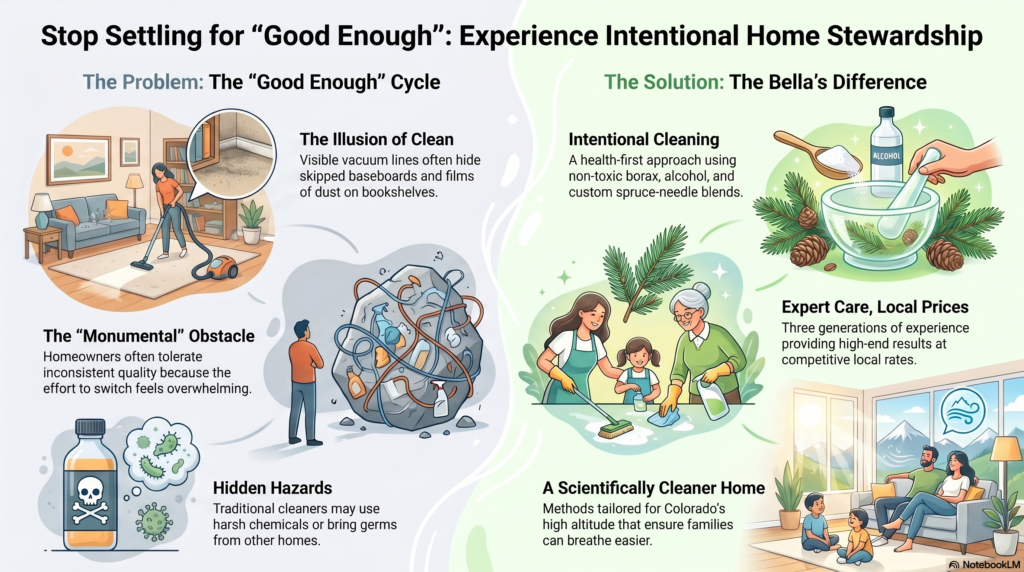
It’s a familiar feeling. The cleaner leaves, and your house looks… fine. The pillows are fluffed, the counters are wiped, and the vacuum lines are still visible on the carpet. But later, as you run your hand along a bookshelf, you feel a film of dust. You notice the baseboards have been skipped again. A vague sense of disappointment settles in, a quiet acknowledgment that you’re paying for a service that consistently falls short. Yet, you do nothing. The bi-weekly cleaning appointment comes and goes, and the cycle of ‘good enough’ continues.
If this sounds like your current situation, you are not alone. This is one of the most common frustrations I’ve heard from new clients over my 25 years in the home stewardship business. They come to us after years of tolerating inconsistent quality, poor communication, or a simple lack of attention to detail from their previous independent housekeeper or residential cleaning service. The problem isn’t that they don’t know they deserve better; it’s that the obstacles to making a change feel monumental.
The Psychology of ‘Good Enough’: Inertia and Confrontation Avoidance
The primary reason we stick with mediocrity is a powerful combination of human psychology. We are creatures of habit, and the simple inertia of maintaining the status quo often outweighs the potential benefit of a change. The thought of starting a new vetting process—searching on platforms like Angi or Thumbtack, reading online reviews, conducting interviews—can feel exhausting. This decision fatigue is a real barrier, especially for busy professionals who barely have time for their own lives, let alone managing another project.
Then there’s the deeply ingrained human trait of confrontation avoidance. Firing someone, even a service provider with whom you have a purely transactional relationship, feels personal and uncomfortable. What will you say? How will they react? It’s easier to just let it slide, to convince yourself that it’s not *that* bad. You’ve built a routine, they know where things are, and you’ve found a way to live with the shortcomings. You’ve settled into a comfort zone, even if it’s a slightly dusty and disappointing one.
I saw a forum post the other day that captured this perfectly. A user wrote something to the effect of, “My cleaner has been with me for what feels like rusty years, but the quality has slipped so much. I don’t know how to bring it up.” I read a reply from another user that said, “I had the same issue years ago. I finally made the switch and my only regret is that I didn’t do it sooner.” That years ago reply is a sentiment we hear almost every week. The perceived hassle is almost always greater than the actual effort required to find a great new service.
The Sunk Cost Fallacy in Housekeeping
Beyond inertia, there’s a cognitive bias at play: the sunk cost fallacy. This is our tendency to continue with an endeavor because we’ve already invested time, effort, or money. You’ve spent months, maybe years, with your current cleaner. You’ve trained them on your preferences, they have your key, and you’ve already paid them thousands of dollars over the years. The thought of “starting over” makes that past investment feel wasted.
The truth, however, is that this money is already spent. Continuing to pay for a service that doesn’t meet your needs or, more importantly, doesn’t contribute to the health of your home, isn’t honoring your past investment. It’s just throwing good money after bad. The real waste is spending another dollar on a service that leaves your home’s microbial history untouched and your family breathing in allergens that should have been removed. Recognizing this fallacy is the first step toward empowering yourself to make a change that will pay dividends in your quality of life and peace of mind.
The Great Misunderstanding: Are You Paying for Tidiness or True Cleanliness?
Here we arrive at the core thesis of our discussion, the fundamental gap in understanding that keeps so many people locked in a cycle of dissatisfaction. The problem isn’t just that your cleaner is “bad” or “lazy.” The problem is that you and your cleaner may have completely different definitions of the word “clean.”
You are likely paying for a tidying service. What you actually need and deserve is a professional cleaning service grounded in health and science. They sound similar, but they are worlds apart in execution and outcome. Tidying creates the *illusion* of clean. It straightens things up, wipes visible spills, and makes a space look orderly for a short time. True cleaning, however, addresses the invisible world within your home—the dust mites, allergens, bacteria, and viruses that impact your health.
A study on environmental psychology found that being in an organized versus messy space significantly influenced positive behaviors, where volunteers were more likely to make healthier food choices in a tidy environment. This highlights the mental benefit of order. But the physical benefit comes from what you can’t see. Many housekeeping services stop at the visual, leaving the microscopic threats behind.
Introducing the Gold Standard: The CDC’s Framework for a Healthy Home
To truly grasp this difference, we don’t need to rely on opinion. We can turn to the ultimate authority on public health: the Centers for Disease Control and Prevention (CDC). The CDC provides a clear, scientific framework that every professional cleaning service should operate within. It’s based on a hierarchy of three distinct actions: cleaning, sanitizing, and disinfecting.
Understanding this hierarchy is the single most powerful tool you have to evaluate your current service and vet a new one. According to the CDC, the definitions are clear: Cleaning removes most germs, dirt, and impurities from surfaces, while sanitizing reduces germs to safe levels, and disinfecting kills most germs on surfaces. This is a critical distinction. Your current cleaner is likely only performing the first step, and perhaps not even effectively.
- Cleaning: This is the physical act of removing organic matter and soil from a surface. It involves soap, water, and friction. You cannot effectively sanitize or disinfect a surface that has not first been cleaned. If your cleaner just sprays a product on a dirty counter and wipes it, they are not following proper protocol. They’re just smearing dirt and germs around.
- Sanitizing: This step reduces the number of bacteria on a surface to a level deemed safe by public health standards. This is crucial for food preparation areas like kitchen counters and cutting boards. It typically requires a specific product that must remain on the surface for a set amount of time (known as “dwell time”) to be effective.
- Disinfecting: This is the highest level, using chemicals to kill viruses and bacteria on surfaces. This is essential for high-touch surfaces and areas like bathrooms, especially during cold and flu season. Like sanitizers, disinfectants require a specific dwell time to work.
Does your cleaner understand these differences? Do they use different products and protocols for your granite countertop versus your toilet bowl? If the answer is no, you are not receiving a professional, health-focused service. You’re getting a superficial tidy-up that may leave your home looking good but failing to protect your family’s well-being.
Uncovering the Invisible Threat: A Health-Risk Audit of Your Current Service
Let’s move from the theoretical to the practical. You can perform a simple “health-risk audit” of your own home after your cleaner leaves. This isn’t about finding fault; it’s about gathering data to make an informed decision. It’s about looking at your home through the lens of a public health expert, not just a homeowner.
High-Touch Surfaces: The Hidden Highways for Germs
Start with the high-touch surfaces. These are the spots that multiple people touch frequently throughout the day, creating transfer points for germs. Think about it: doorknobs, light switches, cabinet pulls, refrigerator handles, remote controls, and stair railings. A tidying service might wipe down the main kitchen counter but completely ignore the handle on the pantry door that everyone grabs.
After your next cleaning, take a close look at these areas. Do they feel truly clean, free of any sticky residue? Or have they been overlooked? A professional service dedicated to health will have a specific protocol for identifying and disinfecting these high-touch surfaces as a standard part of their cleaning checklist. They understand that cleaning the big, obvious surfaces isn’t enough to reduce the spread of illness in a home.
Beyond the Surface: Allergens, Dust Mites, and the ‘Microbial History’ of Your Home
Now, let’s go deeper. The most significant health threats in a home are often airborne and invisible. Dust isn’t just an unsightly nuisance; it’s a complex mixture of dead skin cells, fabric fibers, pollen, pet dander, and microscopic dust mites. For allergy and asthma sufferers, effective dust removal is non-negotiable.
This is where the quality of supplies and equipment becomes paramount. Is your cleaner using a cheap, leaky vacuum that just kicks dust back into the air? A true professional will use a high-quality vacuum, perhaps a Dyson or a Shark Navigator, equipped with a HEPA filter. A HEPA (High-Efficiency Particulate Air) filter is designed to trap 99.97% of particles as small as 0.3 microns. This is the difference between simply moving dust around and actually removing it from your home’s ecosystem.
The same principle applies to cleaning cloths. Are they using old cotton rags or paper towels? Or are they using high-quality microfiber cloths? Microfiber is engineered with fibers that are incredibly fine, creating a larger surface area to trap and hold dust, dirt, and bacteria instead of just pushing them around. A professional service will often use a color-coded microfiber system to prevent cross-contamination—for example, blue cloths for glass, yellow for general surfaces, and red for bathrooms only. This attention to detail prevents germs from the toilet being wiped onto your kitchen surfaces.
We had a client who came to us because her son had severe allergies. She said, “We’ve tried so many services, and it never seems to help.” She told us we were the first service that actually listened and used unscented, non-toxic cleaners and a HEPA-shielded extraction vacuum. A few weeks into our recurring service, she called us, emotional, to say her son was breathing easier in their home for the first time in years. That is the difference. That is the impact of a health-first approach.
When “Clean” Smells Like Chemicals: The Problem with Harsh Products
For many years, the smell of bleach or overpowering artificial fragrances was synonymous with “clean.” We now know better. Those harsh chemical smells are often volatile organic compounds (VOCs) being released into your air, which can cause respiratory irritation, headaches, and other health issues. A home doesn’t need to smell like a chemical factory to be truly clean.
A modern, knowledgeable cleaning professional will prioritize the use of eco-friendly products and green cleaning solutions. They will have a deep understanding of which non-toxic cleaners are effective for which tasks. They might use pH-neutral cleaners for delicate stone, or stabilized hydrogen peroxide-based products that disinfect without leaving harmful residues. They should be able to explain *why* they choose certain products over others, like Method Products or Mrs. Meyer’s Clean Day for general tasks, and what their protocol is for heavier-duty disinfecting when necessary. If your cleaner’s primary tool is a jug of bleach for everything, it’s a sign their knowledge might be rusty and outdated.
The Definitive Vetting Process: How to Hire a True Home Health Professional
You’ve audited your current service, you understand the science of clean, and you’ve made the decision to move forward. Congratulations. Now, how do you ensure you don’t end up in the same situation six months from now? By implementing a rigorous vetting process that prioritizes expertise and professionalism over just a low hourly rate.
Step 1: Redefining Your Needs and Setting Expectations
Before you even post an ad or search on Yelp or Nextdoor, you need to be crystal clear about what you want. The vague desire for a “clean house” is not enough. You need to create a detailed scope of work. Walk through your home and make a list. Do you need baseboard cleaning every visit or quarterly? Do you expect the insides of the kitchen appliances to be wiped down? Do you have specific pet-friendly cleaners you need used? The more detailed you are, the better.
This document, your cleaning checklist, becomes the foundation for your service agreement. It eliminates ambiguity and ensures everyone is on the same page. When you conduct an initial consultation or request an in-home estimate, you can present this list. A true professional will welcome this clarity. They will likely review it with you, offer suggestions based on their experience, and use it to provide an accurate quote, whether it’s flat-rate pricing or an hourly estimate. An amateur might be intimidated or try to brush it off. This is your first filter.
Step 2: The ‘Health-First’ Interview: Ditching Generic Questions
Once you have a few candidates, whether it’s a local cleaning company, a cleaning franchise like The Maids or Molly Maid, or an independent housekeeper, the interview is your most crucial tool. Do not waste it on generic questions like “Are you reliable?” or “Do you have attention to detail?” Everyone will say yes. Instead, use scenario-based questions that test their actual knowledge.
Here are the questions you should be asking:
- “Can you explain the difference between cleaning, sanitizing, and disinfecting to me?”
This is the single most important question. A professional’s answer should align with the CDC framework we discussed. If they can’t articulate the difference, they are not a health-focused provider. Full stop. - “Walk me through your process for cleaning a bathroom during flu season.”
Listen for specifics. They should mention cleaning surfaces first to remove soil, then using a disinfectant. They should talk about focusing on high-touch surfaces (faucet handles, toilet flushers, light switches). They should mention preventing cross-contamination, perhaps by using specific color-coded cloths for the toilet area. - “My kitchen counter is made of [e.g., granite, marble, quartz]. What products and techniques would you use to clean and sanitize it safely after I’ve been preparing raw chicken?”
This question tests their knowledge of material science. A true expert will know that acidic cleaners (like vinegar) can etch natural stone like marble and will recommend a pH-neutral cleaner. They will also describe a two-step process: first cleaning the counter, then applying a food-safe sanitizer and letting it sit for the required dwell time. - “What kind of vacuum do you use, and why did you choose it?”
This reveals their understanding of equipment. The ideal answer involves a vacuum with a sealed system and multi-stage HEPA filtration to ensure allergens and dust are captured, not redistributed. - “How do you handle client-specific requests, like using only unscented products or focusing on pet hair removal?”
This gauges their commitment to service customization. A great service will see these requests as an integral part of their job, not a hassle. They should be able to describe their onboarding process for new clients and how they document and follow special instructions.
The answers to these questions will tell you everything you need to know about a candidate’s professionalism, expertise, and commitment to the health of your home.
Step 3: Verifying Credentials: Insured and Bonded is Just the Beginning
Once you’ve identified a promising candidate, it’s time for due diligence. Do not skip this step. Trustworthiness and reliability are built on a foundation of professionalism.
- Insured and Bonded: This is non-negotiable. Ask for proof of liability insurance. This protects you if the cleaner accidentally breaks a valuable item or damages your property. Being bonded protects you from theft. Any legitimate residential cleaning service will have this documentation readily available.
- Background Checks: If you’re hiring an independent housekeeper, it is wise to run a background check. If you’re using a professional company, ask them about their policy. Do they perform background checks on all their employees?
- Client References and Online Reviews: Don’t just rely on the curated client testimonials on their website. Ask for a list of current client references you can call. A confident provider will be happy to supply them. Supplement this by reading reviews on their Google Business Profile, Yelp, and other third-party sites to get a more balanced picture.
- The Service Agreement: Always get everything in writing. A professional service will provide a written contract or service agreement that clearly outlines the scope of work, pricing, schedule, cancellation policy, and satisfaction guarantee. This document protects both you and the provider and prevents future misunderstandings.
Step 4: The Trial Cleaning Period: An Onboarding Process for Success
Finally, consider the first few cleanings as a trial cleaning period. It’s an opportunity for you to provide feedback and for the cleaner to fine-tune their service to your specific home and preferences. Good communication is critical here. After the first clean, do a thorough walkthrough and provide gentle, constructive feedback. “I love how the kitchen appliances sparkle! Next time, could we pay a little extra attention to the baseboards in the hallway?”
A professional will appreciate this feedback as part of the onboarding process. They want to get it right. If they become defensive or dismissive, it’s a major red flag. This trial period sets the tone for a long-term, successful relationship built on mutual respect and clear expectations.
Unpacking Common Housekeeping Philosophies
As you delve into the world of home care, you might encounter various “rules” or “methods” for cleaning and decluttering. While a professional service handles the deep work, understanding these concepts can help you maintain your home between visits and communicate your priorities more effectively. Many of these ideas are about managing the *things* in our home, which is the precursor to any great clean.
The 80/20 Rule in House Cleaning
What is the 80/20 rule for house cleaning? Known as the Pareto Principle, this concept suggests that 80% of your results come from 20% of your efforts. In cleaning, this means identifying the few tasks that make the biggest impact on the look and feel of your home. For most people, this “20%” includes clearing kitchen counters, making the beds, and doing a quick wipe-down of the master bathroom. Focusing on these high-impact areas can keep your home feeling manageable between professional deep cleaning appointments. When discussing your needs with a new service, you can use this principle to define your priorities for a standard recurring service.
Quick Resets: The 3:30 Rule and the 5-5-5 Rule for Decluttering
Sometimes the issue isn’t dirt, but clutter. Two simple rules can help. First, what is the 3:30 rule for cleaning? This is more of a time-management trick for personal tidiness. It suggests that at 3:30 PM each day, you take 10-15 minutes to reset your primary workspace or living area. This small, consistent effort prevents clutter from building up into a daunting project.
For tackling a bigger mess, what is the 5 5 5 rule for decluttering? While there are a few variations, a popular one involves putting away 5 things, throwing away 5 things, and finding a new “home” for 5 things that were out of place. It’s a simple, non-overwhelming way to make progress. This connects to a broader strategy from tidying experts. A popular method, known as the ‘Five Things Tidying Method,’ posits that any messy room contains only five types of items: trash, dishes, laundry, things that have a place, and things that don’t have a place. This framework simplifies the process of sorting and restoring order. It’s also important to address the root of clutter. Professional organizers often identify a category called ‘obligation clutter,’ which consists of items we keep out of guilt, like unwanted gifts or family heirlooms that don’t suit our lifestyle. Letting go of these things can be incredibly freeing.
The 7 Foundational Rules of Housekeeping
Finally, people often ask, “What are the 7 rules of housekeeping?” While there isn’t one universally agreed-upon list, most professional versions boil down to a philosophy of consistency and efficiency. A common framework includes:
- Clean Top to Bottom: Dust and debris fall downward. Always dust high surfaces before you clean floors and vacuum.
- Work Wet to Dry: For surfaces like floors, tackle sticky spots first, then move to dry mopping or sweeping.
- Gather Your Tools First: Have all your supplies and equipment ready before you start a room to avoid wasted time.
- One Room at a Time: Finish a room completely before moving to the next to maintain focus and see progress.
- Don’t Just Move Clutter, Remove It: Give every item a home. If it doesn’t have one, decide if you truly need it.
- Let Your Products Work: Obey “dwell times.” Spray a disinfectant and let it sit for the recommended time to actually kill germs.
- Make it a Routine: Consistency is key. A little bit of maintenance every day is far easier than a massive cleaning overhaul once a month.
A great professional service will operate on these principles instinctively. Their efficiency and effectiveness come from an ingrained methodology that ensures no step is missed.
Comparing Your Options: Superficial Tidying vs. Scientific Cleaning
Let’s summarize the two distinct approaches you’ll encounter when looking for housekeeping services. Understanding this fundamental difference is the key to making a confident choice. We like to think of it as hiring a Standard Maid Service versus investing in a Professional Home Steward. Standard Maid Service (Focus on Superficial Tidying)
This service model is primarily focused on aesthetics. The goal is to make the home look clean at a glance. Technicians are often trained to work quickly, covering as much ground as possible. They may use all-purpose cleaners for most surfaces and standard equipment. Their checklist is likely centered on visible tasks like wiping counters, vacuuming open floor areas, and making beds. This can be a good, budget-friendly option for those who primarily need help with general upkeep and tidiness.
- Pros: Generally more affordable, widely available, good for basic maintenance and visual order.
- Cons: Often lacks deep cleaning expertise, may use harsh or inappropriate chemicals, can overlook health-critical areas (high-touch surfaces, allergens), inconsistent quality is a common complaint.
Professional Home Steward (Focus on Scientific Cleaning)
This approach treats home cleaning as a science dedicated to protecting the health of the occupants and the integrity of the home’s materials. A Professional Home Steward or a company with this philosophy invests heavily in training, equipment, and products. They understand material science, microbiology, and the correct protocols for cleaning, sanitizing, and disinfecting. Their process is methodical, detail-oriented, and customized to the client’s specific health needs and home finishes. The goal is not just a home that looks clean, but one that *is* demonstrably healthier.
- Pros: Creates a healthier indoor environment by removing allergens and pathogens, protects valuable home finishes with proper care, provides consistent and reliable results, offers peace of mind.
- Cons: Higher price point due to specialized training and equipment, may be harder to find providers with this level of expertise.
Key Decision Factors for a Healthier Home
As you evaluate your options, your decision should hinge on three critical factors that separate the tidiers from the true professionals. The Cleaner’s Understanding of Health Impacts Does the service talk about health? Do they mention removing allergens, improving indoor air quality, or reducing the spread of germs? A service focused on health will use this language naturally. They see their work as contributing to your family’s well-being. They will ask about allergies, pets, and young children not as an afterthought, but as a critical part of their initial consultation to customize your service. They understand the ‘microbial history’ of a home and work to actively reset it with each visit. The Ability to Differentiate Between Cleaning, Sanitizing, and Disinfecting This is the technical litmus test. A professional should be able to explain their protocol for each of these actions and when they are applied. They should have different products for each task and understand the importance of dwell times. If a candidate uses the words “clean,” “sanitize,” and “disinfect” interchangeably, it’s a clear sign that they lack the foundational knowledge to protect your home’s health. Focus on Removing Invisible Buildup Versus Just Visible Neatness A superior service is obsessed with what you *can’t* see. They focus on the greasy buildup on top of kitchen cabinets, the dust accumulation behind the headboard, and the grime in the sliding door track. They use HEPA filter vacuums and microfiber cloths because they know these tools are designed to trap and remove microscopic particles, not just surface dirt. One of our clients once told us, “The day you clean feels like a holiday in my own home.” That feeling doesn’t just come from fluffed pillows; it comes from the deep, refreshing sense that the entire space is truly, healthfully clean—a feeling of lightness in the air itself.
Making the Right Choice for Your Needs
There is no single “best” choice for everyone. The right residential cleaning service depends entirely on your priorities, your lifestyle, and your home. The key is to make a conscious, informed decision rather than defaulting to the easiest or cheapest option out of habit.
For the Health-Conscious Family
If your primary concern is creating a safe and healthy environment for children, pets, or family members with allergies or compromised immune systems, your choice is clear. You need a Professional Home Steward. Your vetting process should focus heavily on their knowledge of non-toxic cleaners, HEPA filtration, and cross-contamination prevention. You should not compromise on this. The slightly higher cost is a direct investment in your family’s health and well-being. Ask specifically about their experience with pet-friendly cleaners and protocols for homes with allergy sufferers.
For the Luxury Estate Owner
If you own a high-value property with delicate and expensive finishes—think natural stone, exotic woods, custom metalwork—your priority must be expertise. You need a discreet professional with a deep, technical understanding of material science. A standard maid service using an all-purpose cleaner could cause thousands of dollars in damage by etching your marble floors or stripping the finish from your custom cabinetry. You are hiring a steward to protect your assets. Your interview should focus on scenario-based questions about specific materials in your home. Insist on seeing robust liability insurance and ask for references from owners of similarly appointed homes.
For the Overwhelmed Professional
If you’re suffering from inertia and decision fatigue due to a demanding career and busy schedule, the biggest hurdle is just getting started. Your goal is to find a comprehensive, reliable service that can provide a total “reset” and then maintain it with minimal effort on your part. Look for a well-established local cleaning company or a highly-rated premium service that offers a satisfaction guarantee. You need a ‘set it and forget it’ solution. Pay for a one-time deep cleaning to begin with. The immediate, dramatic improvement will restore a sense of calm and order, reinforcing the value of your decision and making it easy to commit to a recurring service, like bi-weekly cleaning or monthly cleaning, that keeps your home a sanctuary, not another source of stress.
Ultimately, the power to transform your home from a source of low-grade stress into a haven of health and tranquility is in your hands. It begins with acknowledging that ‘good enough’ is no longer good enough, and arming yourself with the knowledge to demand a higher standard of care. Your home is your most important environment; it deserves to be truly clean.
Here at Bella’s Mountain Vacation Cleaning, we’ve spent more than two decades perfecting a health-first approach to home stewardship. We believe that a truly clean home is one where families can breathe easier, live healthier, and feel a profound sense of peace. For homeowners in the Boulder, Colorado area looking for a service that understands the science behind the shine, we invite you to reach out. Contact our expert team for a personalized assessment and a free, no-obligation in-home estimate to see how we can make a difference in your home.
Related Reading:
- Why your ‘visibly clean’ property gets 4-star cleanliness reviews and what to do about it
- The 5 most common cleaning complaints from Airbnb guests that lead to refunds
- Most common cleaning complaints from Airbnb guests leading to refunds
- How professional cleaning for your Boulder Airbnb unlocks 5-star reviews
- Standard vs deep clean: why the best choice is a strategic cycle