Choosing a House Cleaner in Nederland, CO: What Actually Matters for Your Mountain Home
People ask me all the time how to find a good cleaner up here. My honest answer: stop leading with price. Start with chemistry.
What goes into your home matters. On the Peak to Peak, where we’ve chosen this life on purpose, the clean air, the quiet, the way the Front Range just sits there and it seems strange to invite a bucket full of synthetic chemicals through the front door. But that’s what happens with a lot of cleaning services, and most people never think to ask about it.
I’ve been doing this work for over a decade. I genuinely love it. Cleaning energizes me in a way I didn’t expect when I started, and I consider it an honor to take care of someone’s home. So when I put together this guide for our neighbors in Nederland, Ward, and Rollinsville, I wanted it to be actually useful and not just another list of questions you’ll never ask.
The Mountain Home Problem Nobody Talks About
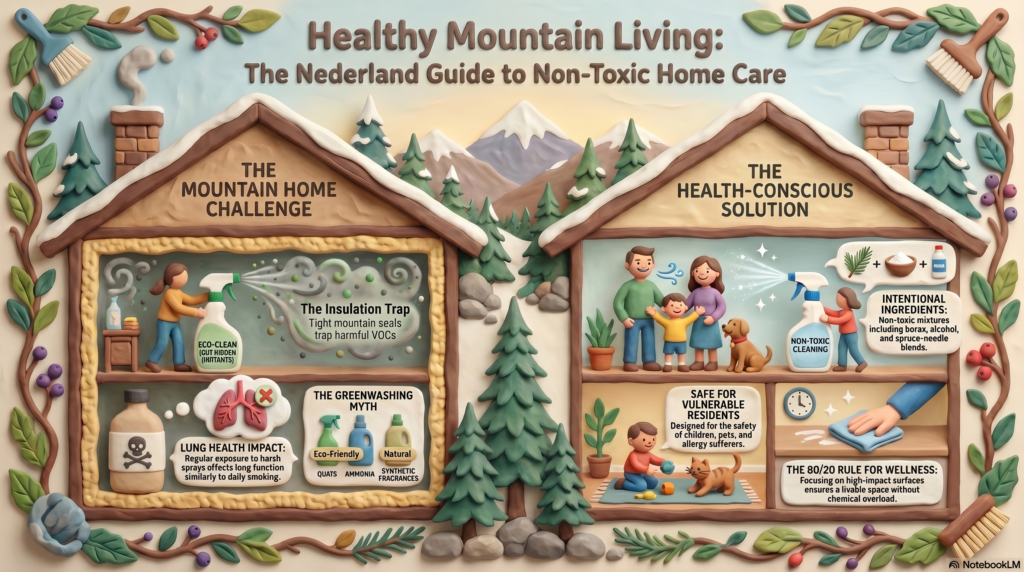
Our homes up here are tight. They have to be because winter near Eldora is no joke. But that same insulation that keeps heating bills manageable also traps everything that gets sprayed, mopped, and wiped inside. According to the American Lung Association, volatile organic compounds (VOCs) released by common cleaning products contribute to chronic respiratory problems, allergic reactions, and headaches, and you know what? Even naturally-derived fragrances like citrus can react with indoor air to form harmful secondary pollutants.
There’s real research on this. A landmark 20-year study published in the American Journal of Respiratory and Critical Care Medicine tracked over 6,000 participants and found that women who regularly used cleaning sprays both at home or professionally, experienced accelerated lung function decline comparable to smoking 10 to 20 cigarettes daily over the course of the study period. That’s occupational exposure, not someone living in a freshly cleaned house but it raises an honest question about cumulative exposure for families, especially in tightly sealed mountain homes with limited ventilation.
For households in Boulder County with children, pets, or anyone with respiratory sensitivities, this isn’t a minor concern. A 2024 review published in the Journal of Allergy and Clinical Immunology confirmed that indoor air quality is associated with increased respiratory symptoms and morbidity even at the lower pollutant concentrations found in well-maintained homes.
“Eco-Friendly” Doesn’t Mean What You Think
A lot of services call themselves green. Most of the time that word is doing very little work.
According to the Environmental Working Group, manufacturers of household cleaning products are not required to fully disclose their ingredients (except in California), and “greenwashing” — making misleading environmental claims — is common across the industry. The EWG notes that some products may highlight one positive attribute while ignoring other harmful ingredients entirely.
The word “biodegradable” is a prime example. As the California Air Resources Board documented, even terpenes from citrus and pine-derived “natural” products can react with indoor ozone to produce formaldehyde and ultrafine particles at concentrations of health concern. Natural origin doesn’t automatically mean safe chemistry.
So instead of asking “are your products green,” ask something specific:
- Can you show me the ingredient list for what you use?
- Are your products free from phthalates, ammonia, chlorine bleach, and synthetic fragrances?
- What do you actually use for disinfection?
- What does “biodegradable” mean to you, specifically?
On the disinfection question: it matters more than most people realize. Quaternary ammonium compounds (quats) all found in the majority of conventional disinfectants, are linked to respiratory and reproductive harm. Children’s Mercy Hospital’s clinical guidance recommends against using quat-based products when children or adolescents are present. Safer alternatives with active ingredients like hydrogen peroxide, citric acid, lactic acid, or ethanol are evaluated and listed by the EPA’s Safer Choice program.
A cleaner who knows their products can answer these questions. One who can’t is worth reconsidering.
Two Different Philosophies
When you’re searching for help, you’ll run into two basic kinds of services.
Conventional cleaning is built around speed and visual results. Strong chemicals work fast and surfaces look great. You can find these services easily on platforms like Thumbtack or Angi, and they’re often cheaper up front. The tradeoff is that harsh products can irritate lungs, leave residue, and use synthetic fragrances that mask odors instead of dealing with them. As the Lawrence Berkeley National Laboratory’s indoor air quality resource documents, VOCs and ammonia from cleaning products can remain airborne for extended periods , they can be affecting anyone in the home afterward, not just the cleaner.
Health-conscious cleaning starts with a different question: what is this doing to the people who live here? The products cost more. The methods sometimes take more time. But you’re not trading your indoor air quality for a lower hourly rate.
Neither approach is secret you just have to know which one you’re hiring.
What to Ask Before You Sign Anything
Good cleaners are transparent. If someone gets cagey about their products or process, that tells you something.
A few things worth covering:
- Are you insured and bonded? Do you run background checks?
- What specific products do you use, and will you work with mine if I prefer something else?
- Do you have a standard scope of work you can share? How do you handle homes with pets?
- How long have you been cleaning mountain homes specifically?
- Can you point me to any reviews — Yelp, Nextdoor, Google?
- How do you price — flat rate or hourly? Do you offer a free estimate?
A Few Common Questions
What’s the 80/20 rule in housekeeping? The idea is that 80% of the feeling of “clean” comes from about 20% of the tasks. Clean kitchen counters, clear entryways, vacuumed floors, wiped bathroom mirrors. A good recurring service masters those high-impact areas so your home stays consistently livable without a full deep clean every time.
How much does a 2-hour clean cost up here? In the Nederland area in 2026, expect somewhere between $100 and $180 for a professional, insured service. That’s usually enough for a light recurring clean in a smaller home but not a deep clean.
What do cleaners wish you knew? Tell us your priorities. If the kitchen is the thing that stresses you out most, say so. Also, tidying clutter before we arrive (toys, papers, stuff on counters) means we can actually clean surfaces instead of moving things around. You’ll get more out of the visit.
Is $50 an hour reasonable? For a legitimate, insured, bonded cleaner in a mountain community, yes, it’s competitive. That rate covers labor, drive time, insurance, taxes, professional-grade non-toxic products, and the cost of running a legal business. If someone’s charging significantly less, it’s worth asking what they’re leaving out.
Vacation Rentals vs. Your Home: Not the Same Job
An Airbnb turnover and a biweekly home clean are genuinely different things. Vacation rental cleaning is about disinfection and presentation on a tight timeline, guests are arriving, photos need to look flawless, reviews are on the line.
A home you live in is different. The goal there is a long-term healthy environment, not a staged photo. The chemistry that makes sense for a quick STR turnover isn’t necessarily what you want soaking into your floors every two weeks.
A versatile service understands this distinction and adjusts accordingly.
Finding the Right Fit
If you’re a parent and safety is your first priority, look for a cleaner who can walk you through their ingredients and explain why each one is appropriate around kids and pets. The NIH’s systematic review on indoor air quality found that VOC sources from household cleaning agents are a primary driver of indoor air degradation, and also that children are especially vulnerable due to faster breathing rates and proximity to the floor.
If you own a vacation rental and care about brand alignment, a genuinely eco-friendly clean is a real differentiator. Guests notice. It shows up in reviews.
If you’re a busy professional who just needs someone trustworthy to handle this without your oversight, the peace of mind is the product. Find someone whose values line up with yours and let them do their job.
The right cleaner for your mountain home is out there. The main thing is knowing what questions to ask before you hand over the key. If you want to talk through your specific situation, home size, rental status, sensitivities, whatever, reach out to us at Bella’s Mountain Vacation Cleaning. We’re happy to do a free assessment and give you a straight answer on whether we’re the right fit.
Related Reading:
Most common cleaning complaints from Airbnb guests leading to refunds
Why your ‘visibly clean’ property gets 4-star cleanliness reviews and what to do about it
The 5 most common cleaning complaints from Airbnb guests that lead to refunds