The Colorado Dust Paradox: Why Your Home Is Never Truly Clean at High Altitude
Standard cleaning fails up here. Not because you are doing it wrong. The environment changes the physics of dust itself. Thin, dry air plus unique geology creates a statically-charged, abrasive mineral dust that normal tools cannot remove. You need a different strategy. One built on environmental control, not just wiping harder.
I clean homes in Boulder County. I see the same cycle every week. Someone spends three hours dusting. Two days later the surfaces look untouched. They blame the HVAC system. They blame the dog. They blame themselves. The real culprit is simpler. It is the altitude.
Living at high altitude in Colorado changes what dust is and how it behaves. Methods that work at sea level are under-equipped for this job. The core problem is that dry, thin air creates a super-charged mixture of fine mineral particles. These particles cling to surfaces with static force. A simple swipe of a duster will not cut it. To get ahead of this, you have to understand the science. Then you have to change your approach.
The Anatomy of High-Altitude Dust: More Rock Than Fluff
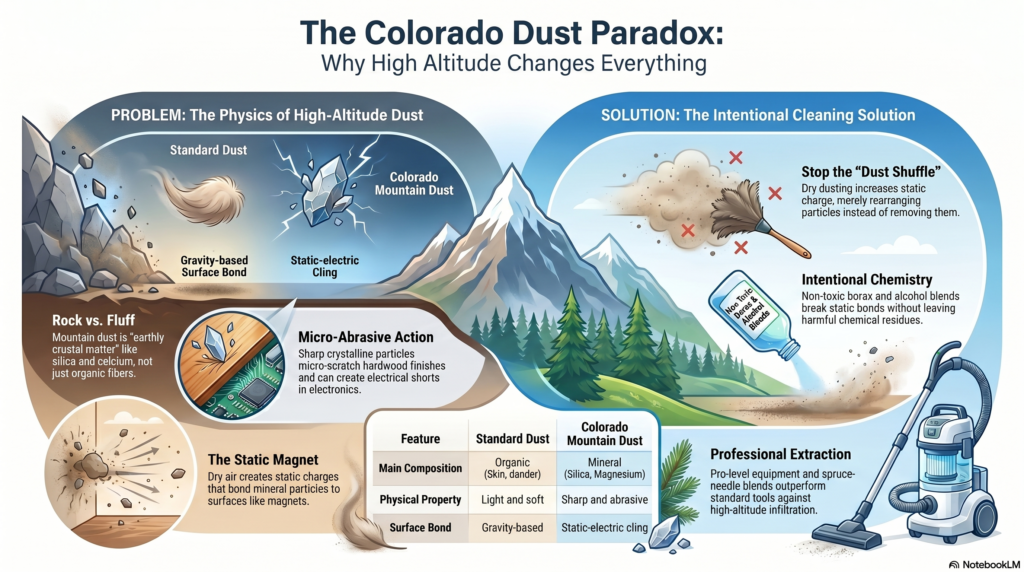
In most American homes, dust is organic. Skin cells. Fabric fibers. Pet dander. Pollen. It is light and manageable. Colorado mountain dust is different. It is less biology and more geology.
Researchers at the University of Colorado have identified that a significant portion of particulate matter in our air is “earthly crustal matter.” Silica. Calcium. Magnesium. These particles become airborne through wind, construction, and the simple disturbance of dry soil on unpaved roads. Officials in Pitkin County call this “fugitive dust.” Watering helps for an hour. Then the dry climate pulls the moisture back out and the dust returns.
This dust is abrasive. The crystalline structure is sharp at the microscopic level. It micro-scratches hardwood. It etches furniture finishes. It is especially rough on electronics. When enough conductive mineral dust builds up inside a computer, it clogs cooling fans and can create tiny electrical shorts on the motherboard. I have seen laptops fail in mountain homes for exactly this reason.
The composition matters because it determines how you fight it. You are not fighting fluff. You are fighting rock.
The Physics of ‘Sticky’ Air: Why Dust Defies Gravity
The dust makeup is only half the story. The other half is the air itself.
Colorado is dry. Everyone knows that. The reason is straightforward. Thin air at high altitude cannot hold as much moisture as dense sea-level air. Relative humidity inside our homes drops to the teens, especially in winter when forced-air heat is running constantly.
Dry air is a factory for static electricity. Air and particles rub against each other and trade electrons. At sea level, humidity in the air dissipates that charge. Up here, there is no moisture to do the job. The charge builds. Dust particles become positively charged. Your electronics, synthetic fabrics, and lacquered wood hold a negative charge. The result is static cling that acts like a magnet. The dust does not settle. It bonds.
This is why a feather duster or dry cloth often makes the problem worse. Wiping increases the static charge. The particles lift into the air, swirl around, and clamp back down on the same surface or the one next to it. You are not removing dust. You are rearranging it.
There is a strange trade-off here. The extreme dryness means far fewer dust mites, which cannot survive in low humidity. So you get fewer biological allergens. But you get a more aggressive, persistent mineral dust in exchange. It is a paradox. You have to work with it.
An Unwinnable Battle: Constant Infiltration vs. Ineffective Removal
Even with the windows closed, dust finds a way inside. Air pressure differences between your home and the outside create a constant, subtle flow. Particles slip through cracks around windows, doors, vents, and any small gap in the envelope.
The situation is worse along the Front Range. Unique airflow patterns trap outdoor air pollution and concentrate it into a visible layer over the landscape. NASA has documented these patterns, showing how mountain topography and weather systems trap particulate matter against the foothills. The air entering your home is already loaded.
Your HVAC system, meant to clean your air, often becomes the distribution network. Standard furnace filters are too coarse to catch these microscopic particles. The dust gets pulled into return vents and blasted back out across the house. Even HEPA filters struggle because the rate of new infiltration outpaces the rate of removal. The EPA notes that indoor pollutant levels can run two to five times higher than outdoor levels, and in some cases up to one hundred times higher. In the Colorado mountains, that is not a theoretical risk. It is your Tuesday.
The Front Range has been in noncompliance with federal ozone standards for years. The Regional Air Quality Council confirms the Denver Metro/North Front Range region is currently in nonattainment for both the 2008 and 2015 ozone NAAQS standards. In 2024, the EPA officially reclassified the region from “Moderate” to “Severe” nonattainment for the 2015 ozone standard. A study published in the National Institutes of Health journal found that the ozone climate penalty alone is delaying NAAQS attainment by approximately two years, with the highest penalties concentrated around major urban centers. The air outside is not clean. That air is what you are fighting inside.
Shifting the Strategy: From Wiping Dust to Controlling Your Environment
If endless wiping is ineffective, the solution is to stop reacting and start managing the environment. Change the physics. Beat the dust at its own game.
Control Humidity
The first step is introducing moisture. A whole-home humidifier tied to your HVAC system can hold indoor humidity between 30% and 40%. That is the sweet spot. Moist enough to kill static electricity and cause dust particles to drop from the air. Not so moist that you invite mold. Once the static is gone, dust stops clinging. It falls. You can actually remove it.
Improve Filtration
Upgrade your furnace filter to a higher MERV rating. MERV 11 or 13 will catch more of the fine particles as they circulate. For bedrooms and main living areas, add portable HEPA air purifiers. They supplement the whole-house system and create clean zones where you spend the most time.
Seal the Leaks
Reduce infiltration at the source. Caulk and weatherstrip around windows, doors, and any openings for pipes or wiring. The less outside air that slips through the envelope, the less dust you have to fight. It is basic air sealing. It works.
Clean Smarter, Not Harder
Stop dry dusting. Use microfiber cloths that are slightly damp with water or a gentle, non-toxic cleaner. The moisture neutralizes static on contact. The cloth fibers trap the dust instead of pushing it around. For floors, use a sealed-system, HEPA-filter vacuum. Standard vacuums exhaust fine particles back into the room. A sealed HEPA system captures them. The EPA recommends phosphate-free soaps and regular attention to indoor air quality sources to protect home systems and family health.
Comparing High-Altitude Cleaning Approaches
Standard dust is mostly organic. Skin, fibers, larger particles. It is less abrasive and less prone to static buildup. Colorado mineral dust is inorganic. Silica and crustal materials. Fine, sharp, and electrostatically charged.
Standard household cleaning relies on dry dusting, sweeping, and basic vacuums. These methods are cheap and familiar. Against statically charged mineral dust, they are largely ineffective. They increase airborne particles and can cause micro-scratches on delicate surfaces.
A science-based high-altitude approach controls the indoor environment first. Humidity. Filtration. Air sealing. Then it uses specific removal techniques. Damp wiping. HEPA vacuuming. This strategy actually removes dust, improves indoor air quality, protects your surfaces, and lasts.
Key Factors for a Healthy Colorado Home
Effectiveness on persistent high-altitude dust. A science-based approach is the only way to get a meaningful, lasting reduction. You tackle the root causes. Static electricity. Constant infiltration. You solve the problem instead of treating the symptom.
Health and safety for your family. The fine particulate matter in high-altitude dust can penetrate deep into the lungs. It exacerbates asthma, allergies, and other respiratory issues. Removing these particles from your indoor environment is not optional if you have kids, pets, or anyone with breathing sensitivities.
Use of non-toxic, eco-friendly products. When your strategy is effective, you need fewer harsh chemicals. Damp wiping with water or a simple pH-neutral cleaner is often enough once the environment is under control. That creates a safer home. American Olean’s stone care guidelines specify that natural stone requires pH-neutral cleaners; acids will etch and damage many stone varieties. The same principle applies to your countertops and floors.
Value and affordability. Investing in a humidifier or hiring a professional who understands this climate is an investment in your health and your property. It prevents long-term damage to surfaces and electronics. It saves hours of frustrating, useless cleaning.
Making the Right Choice for Your Needs
There is no single answer that fits everyone. The right approach depends on your priorities.
The Health-Conscious Parent
Your priority is air quality. Invest in a whole-home humidifier and a high-MERV HVAC filter. Add portable HEPA purifiers in bedrooms. Schedule regular professional deep cleaning, including duct cleaning, to establish a clean baseline and remove years of accumulated buildup from hidden corners. Your kids’ lungs will notice the difference.
The Frustrated Homeowner
You are tired of the cycle. Start by changing the physics. Install a humidifier. It will make the single biggest difference in your daily cleaning. Switch from dry cloths to damp microfiber for every dusting task. That combination alone will dramatically reduce dust’s ability to cling. Your efforts will finally feel effective.
The Vacation Rental Owner
Guest experience drives revenue. A visibly dusty property gets bad reviews. You need impeccable, reliable results every time. A professional cleaning service that specializes in high-altitude environments is a necessity, not a luxury. They ensure consistent cleanliness. They protect your floors and furnishings from abrasive dust. They guarantee your property is guest-ready. Industry data consistently ranks cleanliness as the top factor in guest satisfaction and five-star reviews.
Why This Matters for Your Long-Term Investment
Mountain homes face a moisture problem that compounds the dust issue. Water management is everything up here. A small leak becomes rot. A failing window seal becomes mold. University of Michigan environmental health guidance emphasizes that wooden floors must be dried gradually after water exposure to prevent cracking and warping. The same dry air that creates static dust can also pull moisture out of wood too fast, causing damage.
This is why a cleaner who understands mountain homes acts as more than a service. They are a property steward. They notice the damp spot. They spot the failing seal. They see the signs before they become expensive repairs. At Bella’s Mountain Vacation Cleaning, we built our approach on exactly that philosophy. Learn more about who we are and why we work this way.
The Bottom Line
Overcoming Colorado’s unique dust challenge requires a specialized approach grounded in science. You cannot out-wipe the mountains. You have to out-think them. For homeowners in Boulder County who are ready for a real solution, Bella’s Mountain Vacation Cleaning offers an expert, scientifically-informed service designed specifically for the high-altitude environment. We understand the physics of dust. We provide a meticulous clean that protects your family’s health and your home’s value. Contact our team today for a personalized assessment and a free quote. Let us show you what clean actually looks like at altitude.
RELATED:
Standard vs deep clean: why the best choice is a strategic cycle
Beyond aesthetics: Why a professional deep cleaning is a critical investment