After the Smoke Clears: Why Four Mile Canyon Homes Need a Specialized Deep Cleaning Post-Fire Season
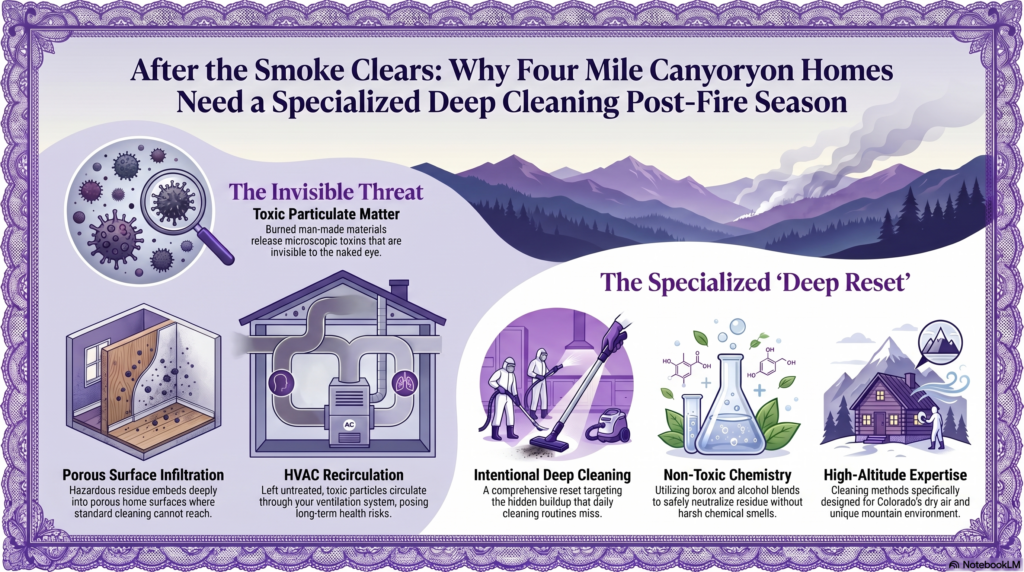
Homes in Four Mile Canyon need specialized deep cleaning after fire season. Not for the ash you can sweep off the deck. For the invisible residue you cannot see. Burned man-made materials release toxic particulate matter that embeds in porous surfaces and circulates through your HVAC. Standard cleaning will not touch it. That residue poses a long-term health risk. You need a different kind of cleanup.
The Lingering Threat After the Flames Are Gone
We build our lives in these mountain communities because the beauty outweighs the risk. When fire season ends, the skies clear. We want to believe the danger passed with the flames. You sweep the deck. You wipe the patio furniture. You think the worst is over.
The real threat is the one you cannot see, smell, or touch. The dust inside your Four Mile Canyon home is not just dirt or wood ash. It is a hazardous byproduct of modern wildfire. Understanding what it actually is marks the first step in protecting your family. This is not housekeeping. It is environmental remediation inside the walls you live in.
The Wildland-Urban Interface Cocktail: A New Kind of Smoke
Twenty-first century wildfires are different. Especially in the Wildland-Urban Interface, where housing meets undeveloped land. When fire moves through or near a community, it does not just burn trees. It incinerates everything. The smoke becomes a chemical cocktail. NIST’s Wildland-Urban Interface Fire Group has documented that these fires involve plastics, synthetic siding, adhesives, resins, solvents, paints, treated lumber, fiberglass insulation, roofing materials, household chemicals, pesticides, fertilizers, metals, and electronics.
That toxic soup travels for miles on air currents. Experts recommend inspection if a home sits within a few miles of large burned structures. Contaminants have been found in homes five miles from a fire. Your house does not need to sit inside the burn scar to suffer significant impact. The ash on your windowsill contains third-party contaminants. That marks the beginning of a deeper problem.
Differentiating Cosmetic Ash from Microscopic Killers
Your home faces two distinct types of contamination after a fire season. Failing to tell them apart is the most common and dangerous mistake a homeowner can make.
Visible Ash and Soot
This is the larger, darker particulate you can see. You wipe it off surfaces with a damp cloth or a specialized soot sponge. It is gritty and obvious. While it can be corrosive and acidic over time, it is mostly a surface issue. The right decontamination techniques can handle it.
Invisible Toxic Particulates (PM2.5)
This is the real danger. These particles are 2.5 micrometers in diameter or smaller. About thirty times smaller than a human hair. Too small to see. Light enough to stay suspended in the air for weeks. The EPA confirms that wildfire smoke contains PM2.5 that can be easily inhaled, and there is no concentration below which health effects have not been observed.
This particulate matter and the volatile organic compounds that accompany it come from burning plastics and chemicals. They contain carcinogens like polycyclic aromatic hydrocarbons, dioxins, and benzene. The National Institutes of Health notes that wildfire-specific PM2.5 has been reported to be more harmful to health than PM2.5 from other sources, and that smoke from WUI fires can contain toxic metals such as lead and mercury, plasticizers, and other pollutants. These particles bypass the body’s natural defenses. They lodge deep in the lungs. They enter the bloodstream. They lead to significant respiratory concerns and potential long-term health effects.
The concentration of these invisible toxins can be alarmingly high indoors. After major fire events along the Colorado Front Range, official indoor air sampling in severely smoke-impacted homes showed benzene levels higher inside than outside. Homes act like containers. They trap and concentrate harmful chemicals long after outdoor air quality improves.
The Failure of DIY Methods: Why Good Intentions Can Make Things Worse
Many homeowners grab a vacuum and a spray bottle and get to work. That initiative is admirable. It often makes the problem worse.
Standard DIY Cleaning Approach
A typical DIY cleanup uses a household vacuum, wet wiping, and air fresheners to mask the smoke odor. Maybe a shop-vac for heavy ash. These methods create a false sense of security. The EPA explicitly warns against using typical household vacuums or shop vacuums to clean up ash, as they send collected dust back out into the air. Standard vacuums lack sealed gaskets. They churn PM2.5 particles through the exhaust and re-suspend the most dangerous material back into the air you breathe.
Wet wiping can smear fine, oily soot. It embeds the residue deeper into porous surfaces like drywall and wood grain. Air fresheners mask odors. They do nothing to eliminate the source. The particles remain.
Professional Specialized Remediation
A professional approach from IICRC-certified technicians follows a scientific process. Containment. Removal. Purification. It starts with a thorough property damage assessment and may include air quality testing. Professionals use true HEPA filtration systems with sealed housings that capture 99.97% of particles down to 0.3 microns. They deploy commercial-grade air scrubbers to continuously clean the air during the project.
Specialized techniques matter. Dry soot sponges remove residue without smearing. Structural cleaning involves hand-detailing every surface with appropriate agents to neutralize acidic residue. For severe smoke odor, thermal fogging or ozone treatment neutralizes odor-causing molecules at their source. It does not just cover them up.
The consensus among disaster recovery experts is clear. Major cleanup after a wildfire requires professionals who have the specific knowledge and equipment to manage the aftermath safely.
Your Home’s Lungs: The Hidden Reservoirs of Contamination
Even if you clean every visible surface, the most dangerous particles have already migrated into the deepest, most hidden areas. Your HVAC system sits at the top of that list.
The Ductwork
The network of ducts behind your walls becomes a repository for toxic soot. Every time your system kicks on, it dislodges those particles and distributes them into every room. A simple vent cleaning is not enough. Full ductwork decontamination is required.
The HVAC Coils
The evaporator and condenser coils have a fine, web-like structure. It traps oily soot. That buildup impedes system efficiency and becomes a source of persistent odor. Specialized HVAC coil cleaning is essential.
The Insulation
Insulation in your attic and crawlspace is porous by nature. It acts like a giant sponge. It absorbs smoke, odors, and toxic particles. In many cases of significant smoke infiltration, the only safe solution is removal and replacement of contaminated insulation.
Wall Cavities
Through tiny gaps and pressure differentials, smoke particles get drawn into the spaces behind your drywall. These areas can off-gas VOCs for months or even years. They contribute to poor indoor air quality and that stubborn smoke smell that never seems to go away.
Without addressing these hidden systems, any surface-level cleaning is temporary. You leave the source of contamination intact. It recirculates. It re-contaminates your living space indefinitely.
A Holistic Approach to Post-Fire Recovery
True recovery extends beyond the interior. A comprehensive plan considers the entire property.
Exterior and Landscape Considerations
Exterior power washing removes soot and ash from siding, decks, and patios. That prevents tracking contaminants inside or letting them become airborne again. Roof and gutter cleaning matters too. Ash accumulation in gutters mixes with rain to form a corrosive slurry that damages materials.
If retardants like Phos-Chek were dropped on or near your property, specialized cleanup may be needed. Retardants can be corrosive to certain materials. Official guidance recommends using a mild detergent with water and brushes to scrub and dilute dried residue, then flushing with clean water. Pressure washing helps but should not replace scrubbing.
Landscape restoration is part of the bigger picture. Planting fire-resistant native species and maintaining defensible space is key to fire season preparedness for any mountain home.
Understanding Wildfire Causes
Homeowners often ask about the cause of a specific fire. The 2010 Fourmile Canyon fire is part of local history. USDA Forest Service research on that fire documented that 168 homes were destroyed, with 83% of those destructions associated with surface fire rather than crown fire. High spread rates and long-distance spotting combined to produce rapid growth that overwhelmed suppression efforts. USGS studies after the same fire found that burned watersheds produced turbidity, dissolved organic carbon, nitrate, and metals that increased by 1 to 4 orders of magnitude during thunderstorms.
Whether a fire starts from lightning or human activity has little bearing on the type of contamination in your home. A fire that burns through a populated area produces the toxic WUI cocktail regardless of ignition source. Your priority must be addressing the hazardous residue left behind.
Making the Right Choice for Your Needs
The decision of how to proceed depends on your situation and your tolerance for risk. There is no universal answer.
The Health-Conscious Parent
Your primary concern is the invisible threat. Children have developing respiratory systems. The CDC reports that children are particularly sensitive to health effects of wildfire smoke because their lungs are still developing, their air intake per body mass is greater than adults, and particle deposition in their lower airways is greater than for adults. During the 2023 Canadian wildfire smoke events, CDC data showed asthma-associated emergency department visits were 17% higher than expected on smoke days, with larger increases among children aged 5-17.
Cost is secondary to certainty. You need documented proof of a healthy environment. Your best path is engaging a professional environmental cleaning company that specializes in fire damage restoration. Look for IICRC-certified technicians who can provide air quality testing before and after remediation. Insist on a detailed plan that explicitly includes HVAC system cleaning, ductwork decontamination, and attic insulation inspection. Your goal is complete removal of unseen soot and ash.
The DIY-Minded Homeowner
You are practical and capable. You believe you can handle most home maintenance yourself. The problem is not your work ethic. Consumer tools are mismatched for this hazard. The EPA advises wearing a tight-fitting NIOSH-approved respirator and avoiding skin contact during ash cleanup, and reiterates that typical household vacuums will send dust back into the air.
Start your DIY efforts on the exterior. You can safely handle power washing and initial ash removal from hard surfaces. For the interior, recognize the limitations. At minimum, consult a professional for an inspection and a quote. A property damage assessment can reveal hidden contamination in your HVAC and attic. You may find a hybrid approach works best. Handle the preliminary work yourself. Leave the life-safety remediation of indoor air quality to experts.
The Vacation Rental Owner
Your concerns are guest safety, business reputation, and liability. A lingering smoke smell leads to negative reviews that haunt your business for years. Failing to properly remediate toxic residue could expose you to liability if a guest with asthma has an adverse reaction. You need fast, thorough, documented work.
Professional remediation is non-negotiable. You need comprehensive documentation of the work performed, including specific treatments used for smoke odor elimination and structural cleaning. That creates a defensible record that you have met your duty of care. Consider a company that offers contents pack-out services to clean and deodorize all textiles, upholstery, and decor. The investment in professional service is an investment in business continuity.
Why Local Experience Matters
I have cleaned homes in this area for over a decade. I know the specific challenges of our mountain environment. I know how smoke behaves in these canyons. I know what the EPA says about PM2.5. I also know that a generic cleaning crew from the flatlands does not understand why your attic insulation matters or how your septic-safe requirements change product selection. At Bella’s Mountain Vacation Cleaning, we built our approach on local expertise and a commitment to non-toxic, family-safe methods. We do not just clean. We restore the health and safety of your home.
The Bottom Line
Protecting your mountain home after fire season means creating a truly safe and healthy space. Free from visible reminders and invisible dangers. It is an act of care for your property, your family, and your peace of mind.
For homeowners in Four Mile Canyon and the surrounding Boulder, CO area, navigating wildfire aftermath can feel overwhelming. Bella’s Mountain Vacation Cleaning brings over a decade of local experience. We combine scientific understanding of post-fire contaminants with a commitment to non-toxic, family-safe methods. We live here. We understand the unique challenges of our mountain environment. We are dedicated to restoring the health and safety of your home. Contact our expert team today for a personalized assessment and a complimentary, no-obligation quote. Breathe easier tomorrow.
RELATED:
Standard vs deep clean: why the best choice is a strategic cycle
Beyond aesthetics: Why a professional deep cleaning is a critical investment