
Beyond the checklist: How to spot a cleaning service scam before it’s too late
To truly avoid a cleaning service scam, you must look beyond basic questions about insurance or products. The key is identifying the psychological tactics, like manufactured urgency and fear-based emotional hooks that con artists use to bypass your critical thinking and secure your trust before you can perform due diligence.
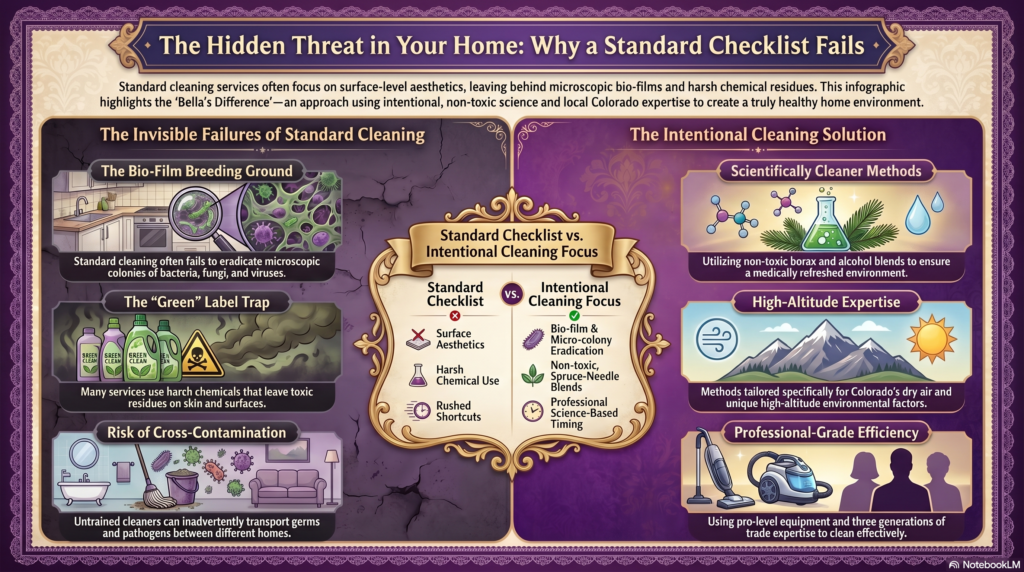
The Hidden Threat in Your Home: Why a Standard Checklist Fails
When you begin the process of hiring a professional cleaning service, your instincts likely guide you toward a logical set of questions. You ask about their rates, their cleaning products, and their availability. You might even remember to inquire about their insurance policy. This is a responsible first step, but it’s dangerously incomplete. It’s like checking the locks on your doors while a professional cat burglar is already studying the blueprints of your home’s psychological vulnerabilities.
From a high-altitude toxicology lens, a home isn’t just a structure; it’s a complex ecosystem. Surfaces harbor more than dust—they are breeding grounds for persistent bio-film, microscopic colonies of bacteria, fungi, and viruses that standard cleaning methods often fail to eradicate. The desire to create a safe, medically refreshed environment for your family is a powerful, primal instinct. And it is precisely this instinct that predatory cleaning services exploit.
They don’t win you over with a superior service; they win you over by manipulating your fears and desires. This article will provide you with the critical questions you need to ask, but more importantly, it will teach you how to listen for what isn’t being said and how to recognize the psychological red flags that signal a scam. We will move beyond surface-level vetting and arm you with the awareness to protect your home, your finances, and your peace of mind.
Spotting the ‘Hook’ vs. a Good Deal
The first point of contact is often where the manipulation begins. A legitimate company might offer a seasonal discount or a new client special, but a scammer constructs a “hook” designed to trigger a strong emotional response. Their goal is to make the offer so tantalizingly good that your critical thinking disengages. New York’s Attorney General’s office warns that scam artists use a ‘hook’ appealing to emotions like ‘fear and desperation’ to cause a person to pay less attention to details or let their guard down according to official guidance.
The Anatomy of a Scam ‘Hook’
Scammers use two primary emotional levers:
- Greed and Desire: This is the classic “too good to be true” price. An offer that is 50-70% lower than any competitor’s written quote should be an immediate cause for suspicion. They prey on your desire for a bargain, hoping you’ll focus on the incredible savings and ignore the lack of a proper business license, a physical business address, or verifiable online reviews. This is the foundation of bait and switch pricing, where the initial low price balloons with hidden fees and undisclosed add-on services once the work has begun.
- Fear and Anxiety: This tactic is more insidious. A scammer might use scare tactics to exaggerate minor issues, framing them as urgent health threats. They might mention things like “toxic mold spores” or “bacterial colonization” after a cursory glance. As experts at This Old House have noted, scammers often use high-pressure sales tactics or claim that expensive repairs must be done immediately, sometimes by using scare tactics to exaggerate minor issues to create a false sense of emergency. They are banking on your protective instincts to override your financial caution. A professional service will provide a calm, factual assessment, often with documentation or testing, before recommending an expensive deep cleaning or remediation service.
A legitimate company’s offer will be transparent. It will have clear terms, an expiration date that is reasonable (e.g., “good for 30 days”), and will be presented as part of a comprehensive, written quote detailing the full scope of work. They want your informed consent, not your impulsive agreement.
The Urgency Red Flag: Why Pressure Is a Confession
Perhaps the most universal tactic among all fraudulent operations is the creation of artificial urgency. If you feel pressured to make a decision on the spot, you are likely being manipulated. This is a deliberate strategy designed to prevent you from doing the very thing that would expose them: research.
Consider these common high-pressure sales tactics:
- “This discounted price is only good for today.”
- “We just had a cancellation, and I have one slot left this week, but you have to book it now.”
- “If we leave and have to come back for another in-home estimate, there will be a travel fee.”
This manufactured scarcity preys on the fear of missing out. As consumer protection resources like LawHelp.org point out, a common tactic scammers use is to pressure you for an immediate decision precisely to stop you from comparing prices or checking their background. A reputable cleaning service understands that hiring someone to come into your home is a significant decision. They will encourage you to take your time, review their service agreement, and compare their offer with other companies. Their confidence is in the quality of their service, not in their ability to rush you into a bad decision. A professional quote should be honored for a reasonable period, typically 15 to 30 days, allowing you ample time for due diligence.
Unmasking Fraud Through Payment Methods
No matter how professional their website looks, how charming their representative is, or how convincing their sales pitch feels, their preferred payment methods can be the ultimate tell. A cleaning company’s insistence on untraceable or unconventional payment is a definitive sign of a scam.
Here’s what to watch for:
- Cash-Only Demands: While some small, legitimate independent cleaner operators might prefer cash, a professional company that *demands* cash only, especially for a large initial deposit, is a major red flag. It suggests they are operating off the books, likely without a business license, and it leaves you with no paper trail if they disappear.
- Wire Transfers, Zelle, or Venmo for Deposits: These methods are akin to sending cash. Once the money is sent, it’s nearly impossible to recover. Scammers love these platforms because they lack the fraud protection built into credit cards. A legitimate business will never pressure you to use a peer-to-peer cash app for a deposit.
- Gift Cards: This is the most glaring red flag of all. No professional service in any industry will ever ask for payment in the form of gift cards (iTunes, Google Play, Amazon, etc.). This is the exclusive domain of criminals.
Professional cleaning services will offer standard, traceable payment methods like credit cards, checks, or a secure online payment portal. This not only provides a record of the transaction but also offers you a layer of consumer protection. The ability to dispute a credit card charge is a powerful recourse if the company fails to provide the agreed-upon work. This financial accountability is a hallmark of a legitimate enterprise. Scammers are well aware of this, which is why they avoid these methods at all costs. It’s a sad reality that fraudulent activities cost consumers billions, with older adults often targeted; according to the Federal Trade Commission, people in their 60s and 70s who report being defrauded have median losses of $666 and $1,000, respectively highlighting the financial risks involved.
Listening for Evasion: Asking Questions That Demand Proof
This is where the checklist becomes a tool for interrogation, not just information gathering. A scammer has a script of trustworthy-sounding, vague answers. Your job is to ask pointed follow-up questions that force them to provide specific, verifiable proof.
Anyone can say, “Yes, we’re insured.” The real test is in how they respond when you dig deeper. The Better Business Bureau wisely advises that any individual or business hired for cleaning should be bonded and insured to protect the customer in case of breakage, theft, or injury on the job. Here’s how to structure your inquiry:
Vague Question: “Are your employees background-checked?”
Scammer’s Answer: “Oh, absolutely. We take your safety very seriously and all our people are trustworthy.”
Your Follow-Up Questions: “That’s great to hear. Can you describe your employee screening and vetting process? What specific types of background checks do you run? Do you use a third-party service for this?” A legitimate company will have a clear, established policy and won’t hesitate to describe it. They know their investment in a thorough background check is a key selling point.
Vague Question: “Are you insured?”
Scammer’s Answer: “Yes, we are fully insured and bonded.”
Your Follow-Up Questions: “Could you please provide a certificate of insurance? I’d like to verify your liability insurance and worker’s compensation coverage. What is the limit on your bonding policy?” This is the moment of truth. A professional, insured company can and will provide this document, usually via email within minutes. It is standard practice. Hesitation, excuses (“Our agent is out of the office,” “It’s not our policy to share that”), or an inability to produce this document is a deal-breaker. It means they are either lying or underinsured, both of which put you at immense risk.
Vague Question: “Do you have good reviews?”
Scammer’s Answer: “We have many happy clients. We’ve been doing this for years.”
Your Follow-Up Questions: “Where can I read your online reviews? Do you have a profile on Google, Yelp, or the Better Business Bureau (BBB)? Could you provide me with a few professional references I can contact?” Scammers often rely on generic customer testimonials on their own website, which are easily faked. They will resist pointing you to third-party sites where they cannot control the narrative. A company with a long history of quality service will be proud of their public reputation and happy to provide references.
By asking for specifics—the “how,” the “what,” and the “proof”—you move the conversation from trust-based assertions to fact-based verification. This is a landscape where fraudulent operators cannot compete.
Common Cleaning Methodologies vs. Professional Protocols
While you’re vetting a company, you may hear about various cleaning “rules” or “methods.” It’s helpful to understand these common household tips to differentiate them from the comprehensive, science-backed protocols a professional service should use. These rules are fine for daily tidying but are not a substitute for a professional scope of work.
- What is the 3 minute rule in cleaning? This is a personal productivity hack. If a task takes less than three minutes to complete (like wiping a counter or putting away a few dishes), you do it immediately to prevent small messes from piling up.
- What is the 1% rule for cleaning? This refers to dedicating 1% of your day—about 15 minutes—to cleaning and decluttering. It’s a strategy for maintaining a baseline level of cleanliness over time through consistent, small efforts.
- What is the 20 10 rule for cleaning? This is a time management technique, often applied to decluttering. You work for 20 minutes and then take a 10-minute break. This cycle helps maintain focus and prevent burnout during larger projects.
- What are the 5 basic cleaning principles? These generally refer to a top-to-bottom, left-to-right cleaning process to ensure efficiency. The principles involve starting high (dusting ceiling fans) and working your way down (vacuuming floors), and cleaning systematically across a room to avoid re-contaminating areas you’ve already addressed.
A professional cleaning service operates on a much more detailed level. Their work is guided by a formal cleaning checklist, safety protocols to prevent cross-contamination, knowledge of which cleaning supplies are effective on specific materials, and the use of professional-grade equipment, such as HEPA filter vacuums and EPA-approved disinfectants.
Making the Right Choice for Your Needs
The “best” vetting strategy is not universal; it depends on your specific priorities and vulnerabilities. By understanding your own profile, you can focus on the red flags most relevant to you.
The Health-Conscious Parent
Your Needs: Your primary concern is the safety of your children and pets. You want to ensure the home is free from harmful germs, allergens, and toxic chemical residues.
Your Vulnerability: You are highly susceptible to fear-based emotional triggers. A scammer can easily exploit your parental instincts by using alarming but unsubstantiated claims about “invisible toxins” or “aggressive bacteria” to upsell you on expensive, unnecessary deep cleaning services.
Your Strategy: When a cleaner mentions a health threat, demand data. Ask, “What is your protocol for preventing cross-contamination between bathrooms and kitchens?” and “Can you provide the Safety Data Sheets (SDS) for the eco-friendly products you use?” A professional will welcome these questions and have ready answers. An amateur or scammer will falter. Insist on specifics about their pet-friendly cleaning options and allergy-specific cleaning protocols, such as the use of HEPA filter vacuums.
The Skeptical Homeowner
Your Needs: You demand proof and value transparency above all. You want to see the paperwork—the business license, the insurance certificate, the written service agreement—before making any commitment.
Your Vulnerability: Your skepticism might make you immune to emotional hooks, but you could be worn down by a scammer who presents a facade of overwhelming professionalism. They might have a glossy website and a slick script, hoping you’ll accept their performance in place of actual credentials.
Your Strategy: Trust but verify, always. Don’t just ask if they have liability insurance and a bonding policy; demand the certificate of insurance and verify it with the issuing agency. Ask for their business license number and check it with your state’s registry. A legitimate business will never see this as an insult; they will see it as a sign that you are a serious, responsible client. Refuse to proceed until every piece of documentation is in your hands.
The Busy Vacation Rental Owner
Your Needs: Your priorities are reliability, efficiency, and a consistently high-quality result to protect your investment and secure 5-star reviews. You need a team that can work independently and handle turnarounds quickly.
Your Vulnerability: Your focus on speed and efficiency makes you susceptible to deals that promise a quick, cheap fix. You might be tempted by a service that offers an incredibly low flat rate and immediate availability, only to find they perform a superficial clean, have a high staff turnover rate, or disappear when a guest reports a problem.
Your Strategy: Focus your questions on process and reliability. Ask about their complaint resolution process and satisfaction guarantee. Inquire, “What is your re-clean policy if a guest is unsatisfied?” and “What are your key security policy and home access procedures?” A service geared toward vacation rentals will have robust, well-defined systems for all these scenarios. They will understand the importance of a dedicated cleaner or a consistent team cleaning approach to maintain quality over time.
Ultimately, safeguarding yourself from a cleaning scam is an active process. It requires moving beyond a passive checklist and engaging critically with the person you are considering hiring. By learning to recognize the psychological games, demanding verifiable proof, and trusting your gut when something feels off, you can confidently choose a professional service that will genuinely enhance the safety and sanitation of your home.
Here at Bella’s Mountain Vacation Cleaning, we have built our reputation on a foundation of scientific rigor and absolute transparency. We believe an informed client is our best partner in creating a medically refreshed environment. For homeowners in Boulder, Colorado, and the Greater Boulder Area who require a higher standard of clean, we invite you to contact our expert team for a no-pressure consultation and a detailed, written quote today.
RELATED: Standard vs deep clean: why the best choice is a strategic cycle
Beyond aesthetics: Why a professional deep cleaning is a critical investment for Boulder
What’s really included in a Boulder professional deep clean for a healthier home?
Why does my house still feel dusty after cleaning? Feedback loops to break
The 2026 Cleaning Consumer Guide