The Clinical Standard of Clean: How the Bella’s Mountain Consumer Guide Protects Your Boulder County Home
As a home health nurse and a third-generation cleaning professional, I have spent my career at the intersection of clinical safety and domestic hygiene. In the nursing world, we understand that a “clean” environment isn’t about aesthetics; it is about the absence of pathogenic load and toxic residue. In the cleaning world, my family has passed down the rigorous standards of deep-tissue home maintenance for decades.
Choosing a cleaner in the Boulder County area is no longer just a matter of finding someone to “tidy up.” In our unique high-altitude environment, the stakes are significantly higher. The Bella’s Mountain Vacation Cleaning Consumer Guide was developed to bridge the gap between traditional “surface cleaning” and modern, science-based health protocols. This post explores how this resource serves as your frontline defense against home health hazards and industry scams.
The Science of Toxicology in Your Living Room
When I walk into a home, I don’t just see dust; I see particulate matter and chemical footprints. Most homeowners in Boulder County are unaware that the very products used to “clean” their homes are often contributing to a decline in respiratory health. We have moved past the era where a “lemon-fresh” scent indicated safety. In reality, those synthetic fragrances are often a mask for Volatile Organic Compounds (VOCs).
According to researchers at the US Environmental Protection Agency (EPA), concentrations of many VOCs are consistently higher indoors, even up to ten times higher than outdoors. These chemicals can cause eye, nose, and throat irritation, headaches, and even damage to the liver and kidneys. When you use the Consumer Guide to vet a cleaner, you are specifically looking for professionals who understand the toxicology of their toolkit.
The Problem with “Old School” Chemical Cocktails
The “old ways” of cleaning relied heavily on high-pH corrosives and ammonia-based products. As a nurse, I have seen the long-term impact of these irritants on patients with asthma and COPD. Choosing a cleaner who still relies on these outdated methods is a risk to your family’s long-term wellness. Modern science-based cleaning, as outlined in our guide, prioritizes neutral-pH cleaners and mechanical removal over chemical “killing.”
The Invisible Hazard of Mountain Dust and Silica
In Colorado, our geography presents unique challenges. We deal with high levels of mineral-heavy dust and, in areas with recent construction or granite surfaces, respirable crystalline silica. As reported by the Occupational Safety and Health Administration (OSHA), these tiny particles can travel deep into the lungs and cause permanent damage. A standard vacuum without a HEPA-certified filtration system, it is a common tool for unvetted “solo” cleaners and simply picks up this dust and aerosolizes it, making it easier for your family to inhale.
Understanding Interdependent Risk: Why Your Cleaner’s Habits Affect the Community
One of the most critical concepts we emphasize at Bella’s Mountain is interdependent risk. This is the idea that the hygiene of your home is not an isolated event. When a cleaner moves from a high-traffic vacation rental in Sugarloaf to a private residential home in Boulder using the same mop head or un-sanitized vacuum, they are creating a biological bridge between environments.
The “Dirty Mop” Pandemic
If a cleaner uses the same equipment in multiple homes without a validated sanitization protocol, they are effectively “sharing” the pathogens of the entire community with you. This cross-contamination is how Norovirus and seasonal flus spread through neighborhoods. According to studies published by the National Institutes of Health (NIH), household cleaning tools like washing machines and sponges can paradoxically serve as reservoirs for opportunistic pathogens if not managed with clinical precision.
Environmental Stewardship in Boulder County
Interdependent risk also applies to our local ecosystem. The chemicals washed down your drains in Boulder or Black Hawk eventually impact our shared water table. By following the guide’s recommendations for eco-responsible cleaning, you are protecting not just your drains, but the broader Colorado environment.
The Red Flags: How to Identify a Cleaning Scam Before It Happens
The Boulder markets are currently flooded with “gig economy” cleaners and unvetted individuals from online marketplaces. While their lower prices may seem attractive, they often mask significant risks. The Consumer Guide provides a checklist to help you see past the “surface sparkle” and identify professional red flags.
The Insurance and Liability Gap
Many homeowners assume that their homeowner’s insurance covers a cleaner who is injured on their property. This is a dangerous misconception. If a cleaner is not “insured and bonded” by a legitimate company, you the owner may be liable for medical bills and lost wages if an accident occurs. Our guide teaches you how to verify coverage rather than taking a verbal “yes” at face value.
Bait-and-Switch Pricing Models
A common tactic in the “old way” of cleaning is to offer a low-entry price only to add “extra” fees for basic tasks like cleaning the inside of a microwave or handling pet hair. The American Lung Association notes that even “natural” cleaners can be used improperly to justify higher costs. A professional service will provide transparent, flat-rate, or clearly defined hourly pricing based on the actual science of the square footage and soil level.
The Sandra Rose Bio: Why a Clinical Perspective Matters
At the heart of the Bella’s Mountain Vacation Cleaning Consumer Guide is the expertise of Sandra Rose. With a background in healthcare and a legacy in the cleaning industry, Sandra has revolutionized how we approach /residential-services. Her systems aren’t just marketing terms; they are a structural approach to home health.
By mapping a home into high-touch, high-risk, and environmental zones, we ensure that no area is overlooked and that cross-contamination is physically impossible. This level of detail is what you should demand from any service you hire in the area. You can learn more about this philosophy on our about-us page.
Colorado-Specific Challenges: High Altitude and Hard Water
Our environment in the Boulder County area is unique, and your cleaner must understand these local variables.
Hard Water and Mineral Management
Boulder and the surrounding areas often struggle with high mineral content in the water. Over time, these minerals can etch into glass and “choke” plumbing fixtures. A “standard” cleaner will often use abrasive acids to remove these stains, which can permanently damage the finish of high-end fixtures. Our guide details the “new way” via using chelating agents that bond to minerals and lift them away without damaging the underlying surface.
The Low-Humidity Dust Cycle
In the dry Colorado air, dust becomes more static-charged and adheres more aggressively to surfaces. This is why many homeowners feel their house is “dusty again” just 24 hours after a clean. We utilize specialized microfiber technology and anti-static treatments to ensure that the clean lasts, providing better value for your investment in deep-cleaning.
How to Use the Guide to Vet Your Next Cleaner
When you download the guide, treat it as your “Standard Operating Procedure” for hiring. Use the following steps to ensure you are getting a professional who meets the Bella’s Mountain standard:
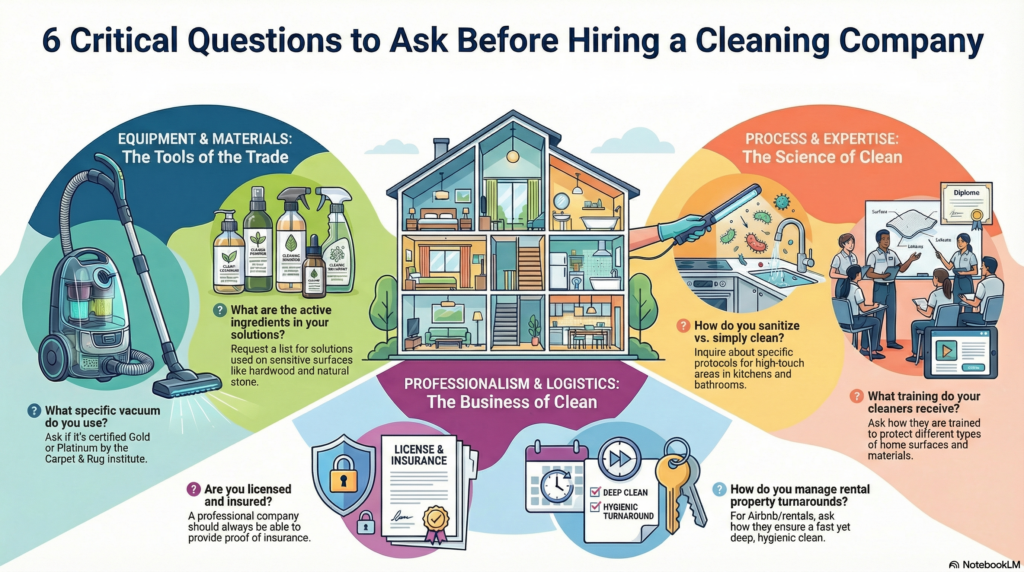
- Request the SDS: Ask the company for the Safety Data Sheets (SDS) for the products they use. A professional company will have these readily available. If they don’t know what an SDS is, they aren’t trained in chemical safety.
- Verify the Equipment Chain: Ask how their vacuums and mops are sanitized between houses. Look for companies that use color-coded systems to prevent a bathroom cloth from ever touching a kitchen counter.
- Check for Professional Certification: Are they trained in the latest health-based cleaning protocols? Do they understand the science of dwell time (the amount of time a disinfectant must stay wet on a surface to actually work)?
Conclusion: Making the Move to a Healthier Home
Your home should be a sanctuary, not a source of chemical exposure or a hub for community pathogens. The Bella’s Mountain Vacation Cleaning Consumer Guide is more than just a pamphlet; it is a clinical tool designed to empower homeowners in Boulder County and surrounding mountain communities to make informed, health-focused decisions.
Don’t settle for the “old ways” of surface-level cleaning. Demand a service that understands the science of your home and the health of your family. If you’re ready to experience a standard of clean that is nurse-approved and science-backed, we invite you to explore our vacation-rental or residential-services to see the difference for yourself.
Related Reading:
- Why your ‘visibly clean’ property gets 4-star cleanliness reviews and what to do about it
- The 5 most common cleaning complaints from Airbnb guests that lead to refunds
- Most common cleaning complaints from Airbnb guests leading to refunds
- How professional cleaning for your Boulder Airbnb unlocks 5-star reviews
- Standard vs deep clean: why the best choice is a strategic cycle