Why Colorado road salt is destroying your Lafayette hardwood floors and the scientific way to clean it
The destructive white film on your Lafayette hardwood floors isn’t from generic road salt. It’s magnesium chloride, an aggressive de-icer used in Colorado that pulls moisture from the air and damages wood fibers. A proper cleaning response requires chemical neutralization with a mild acid, not just surface wiping with water.
The Persistent Problem in Lafayette Homes: A Recurring White Haze
If you live anywhere in Lafayette, from the neighborhoods near Waneka Lake to the developments along South Boulder Road, you’ve seen it. Every winter, a stubborn, milky-white haze appears on your beautiful hardwood floors. You place boot trays and entryway mats, enforce a strict shoe removal policy, yet the crystalline residue always finds its way to your high-traffic areas. You mop the floor, and for a moment, the rich color of the wood returns. But within hours, as the surface begins to dry, the ghostly film reappears. This frustrating cycle isn’t a sign of poor cleaning; it’s a chemical reaction happening right on your floorboards.
The problem is that what you’re fighting isn’t just “road salt.” The common assumption is that this is sodium chloride, the same rock salt you might sprinkle on your own walkway. But the reality of winter road maintenance along the Colorado Front Range is far more complex and, for your wood floors, far more dangerous.
The Chemical Culprit: Why Magnesium Chloride is Not Your Average Salt
To keep roads safe during the icy winters we experience in Boulder County, the Colorado Department of Transportation is a long-time user of liquid deicers, including liquid magnesium chloride (MgCl_2). This chemical compound is chosen for a very specific and powerful reason: it is highly effective at melting ice in the extremely low temperatures common in the shadow of the Rocky Mountains. In fact, technical studies show that magnesium chloride and calcium chloride remain effective at much lower temperatures than standard sodium chloride.
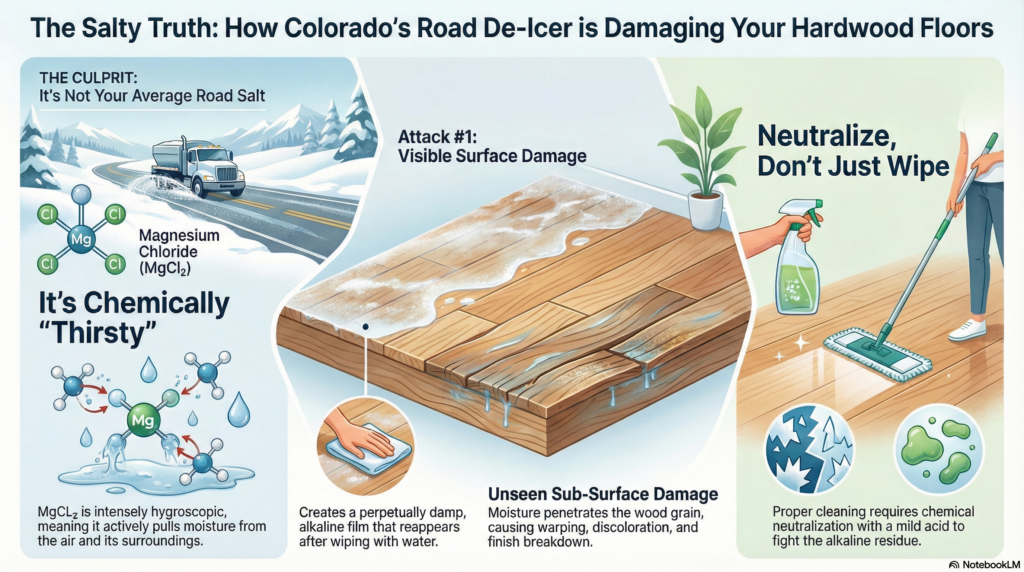
However, the very property that makes it an excellent de-icer is what makes it so destructive to your home’s flooring. Magnesium chloride is intensely hygroscopic, meaning it actively attracts and absorbs moisture from its surroundings. It is so aggressive that it will absorb water out of the air at a relative humidity of 33% or higher, creating a perpetually damp surface. While traditional rock salt is largely abrasive, MgCl_2 wages a chemical war on your wood.
The Two-Front Attack on Your Hardwood Floors
When this liquid de-icer is tracked into your home, it launches a two-pronged assault on your hardwood. According to maintenance standards from the National Wood Flooring Association (NWFA), these liquid residues create a unique set of challenges compared to traditional salt. Because they remain in a liquid or “brine” state longer, they are easily spread across large surface areas, leading to both visible surface damage and unseen, long-term structural harm.
1. Surface Damage: The Visible Haze
As the water it’s dissolved in evaporates, the magnesium chloride recrystallizes, forming the white, powdery residue you see. Because it is hygroscopic, it constantly pulls trace amounts of moisture from the air, creating a slightly damp, alkaline brine on the surface of your polyurethane finish. Wiping with a wet cloth often just re-dissolves the salt, spreading it into a thinner layer that reappears as soon as it dries.
2. Sub-Surface Damage: The Unseen Threat
This is the more insidious problem. The persistent moisture created by MgCl_2 can slowly penetrate microscopic cracks in your floor’s finish. It seeps into the wood grain itself, damaging the cellular structure of the lumber. This leads to:
- Discoloration: Dark spots where the brine has reacted with the wood tannins.
- Sealant Breakdown: The alkaline nature of the brine can chemically soften certain finishes.
- Structural Deformation: Over time, the localized “damp state” causes the wood to expand, leading to warping or cupping of the floorboards.
The Lafayette Factor: How Our Local Climate Worsens the Damage
Living in Lafayette, CO, presents a unique environmental challenge that exacerbates this chemical damage. Our Front Range climate is known for its low humidity and intense, high-altitude sun. This combination creates a perfect storm for magnesium chloride destruction.
During a dry winter day, the indoor relative humidity in a Lafayette home can easily drop below 30%. In this environment, the “thirsty” magnesium chloride residue on your floor becomes even more aggressive. Unable to pull sufficient moisture from the air, it will start to wick moisture directly out of your hardwood floors themselves, dehydrating the wood and stressing the finish. Then, when the intense Colorado sun shines through a window, it can bake this corrosive chemical residue directly into the urethane finish, causing permanent etching and dullness that no amount of cleaning can remove. This is why preventing the residue from lingering is critical.
Beyond Mopping: The Correct Professional Cleaning Protocol
So, if mopping with water just spreads the problem, how do you remove the residue and protect your investment? The answer lies in chemistry. You must neutralize the salt before you can clean it. This is a crucial distinction that separates a superficial wipe-down from a true professional cleaning service.
This directly answers the question homeowners often have: What will neutralize road salt? The salt residue is alkaline, so to remove it effectively, you must first treat it with a mild, balancing acid. A proper hardwood floor maintenance plan for winter must include this step.
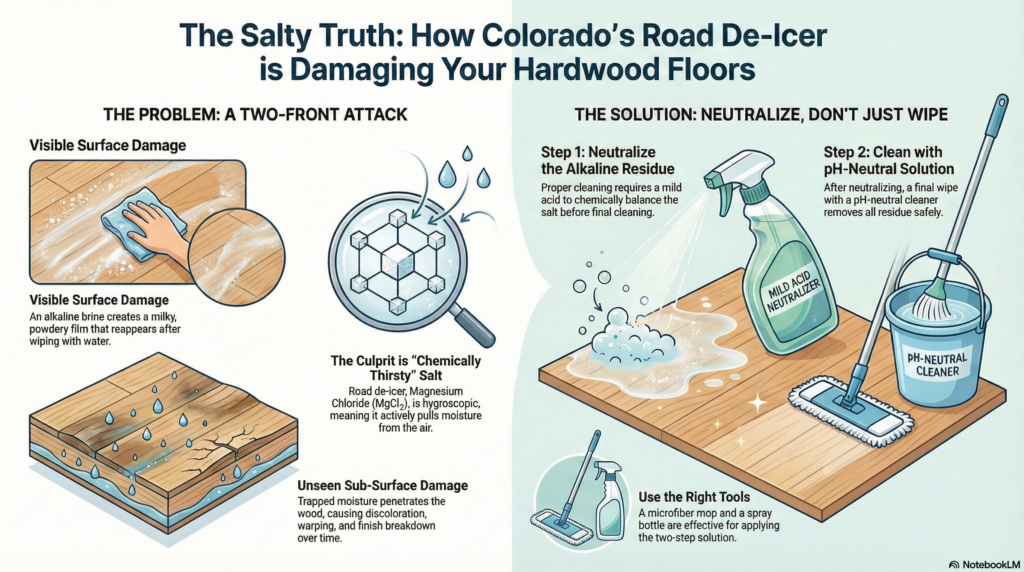
The Two-Step Neutralization and Cleaning Process
- Step 1: Chemical Neutralization. The first step is to apply a salt neutralizer. For DIY spot treatment, a heavily diluted solution of white vinegar and water can work in a pinch (roughly one cup of vinegar per gallon of water). However, for a whole-floor treatment, cleaning professionals use commercial-grade, pH-balanced salt neutralizers. These are specifically formulated to break down the alkaline salts without harming the delicate polyurethane finish of modern wood floors. The solution is applied with a microfiber mop, allowed to dwell for a few minutes to dissolve and neutralize the crystalline residue, and then thoroughly removed.
- Step 2: pH-Neutral Cleaning. After the salt stains and residue have been chemically neutralized and removed, the second step is to clean the floor with a high-quality, pH-neutral hardwood floor cleaner. This removes any lingering acidic solution and everyday dirt, leaving the floor truly clean and free of damaging chemicals. This is the only way to effectively get rid of salt and prevent the recurring white haze.
Comparing De-Icers and Cleaning Methods
Understanding the options and their consequences is key to protecting your flooring.
Generic Road Salt (Sodium Chloride)
Pros: Inexpensive and widely available. Less chemically aggressive than chloride alternatives.
Cons: Primarily works through abrasion, leading to abrasive scratches on a floor’s finish. It is less effective at the very low temperatures we often see in Lafayette, CO. Its damage is mostly physical, not chemical.
Magnesium Chloride (MgCl2)
Pros: Highly effective at melting ice and snow in extreme cold. As a liquid, it stays on the road surface better.
Cons: Extremely damaging to hardwood floors due to its hygroscopic nature. It creates a persistent brine that penetrates wood grain, damages the finish, and promotes moisture-related problems like warping.
Surface-Level Wiping vs. Chemical Neutralization
Surface Wiping: A temporary fix at best. Using only water or a standard floor cleaner re-dissolves the MgCl2, spreading it across the floor. The white film returns as it dries, and the underlying chemical damage continues.
Chemical Neutralization: The only effective, long-term solution. It chemically alters the salt residue, breaking its bond with the floor’s finish and allowing it to be completely removed. This stops the cycle of damage and protects the wood.
Key Factors When Choosing a Cleaning Service
When your high-value assets are at risk, you need more than a simple cleaning. You need a specialist. Here are the critical factors to consider when hiring a service to handle winter salt damage in your Lafayette home.
Cleaner’s understanding of the specific chemical (MgCl2) causing damage.
Do they talk about “salt” in general, or do they understand they are dealing with magnesium chloride? A true professional will know the specific threat posed by CDOT’s de-icing agents and won’t treat it like common rock salt.
Use of a cleaning process that chemically neutralizes the residue.
Ask about their process directly. Do they use a two-step method involving a salt neutralizer? If their answer is just “a good mop and cleaner,” they do not have the right protocol to protect your floors.
Effectiveness in preventing long-term, costly floor damage.
The goal isn’t just a clean-looking floor for a day; it’s the prevention of cumulative damage that could lead to expensive floor refinishing or even floor restoration down the line. A proper service is an investment in prevention.
Safety of the cleaning solutions for children, pets, and indoor air quality.
Professional salt neutralizers and pH-neutral cleaners should be non-toxic and safe for your family and pets. Ensure any company you hire is transparent about the products they use and their safety profiles, especially concerning pet paw cleaning and contact.
Making the Right Choice for Your Needs
Choosing how to protect your floors is a personal decision based on your priorities. There is no single “best” answer, but here is some guidance based on different homeowner perspectives.
- For The Meticulous Homeowner: You’ve invested significantly in your beautiful oak or maple solid wood flooring, and you see it as a core asset of your home. Your primary goal is asset protection. For you, seeking a specialized service that explicitly understands and treats magnesium chloride damage is not a luxury; it’s essential maintenance. A scientifically-backed, two-step neutralization process is the only approach that aligns with your goal of preventing costly surface damage and long-term harm.
- For The Health-Conscious Parent: Your main concern is the indoor environment where your children and pets play. The thought of unknown, harsh road chemicals lingering on your floors is unsettling. You should prioritize a cleaning service that not only removes the chemical residue but does so using non-toxic, biodegradable solutions. The focus is on a deep cleaning method that ensures complete residue removal for better indoor air quality and the safety of your loved ones.
- For The Eco-Conscious Colorado Resident: You value living in harmony with our unique Front Range environment. You appreciate a scientific approach that is both effective and responsible. A service that uses targeted chemistry—a mild acid to neutralize a specific alkaline—appeals to your desire for an intelligent, non-brute-force solution. Using the right tool for the job minimizes the need for harsh, broad-spectrum chemicals, respecting both your home’s interior and the broader ecosystem.
Ultimately, tackling the persistent winter film on your hardwood floors requires moving beyond outdated cleaning methods. Understanding that the problem is the specific chemistry of magnesium chloride is the first step. The next is to implement a cleaning protocol that directly counteracts that chemistry. This approach doesn’t just clean your floors for today—it protects your investment for all the Colorado winters to come.
At Bella’s Mountain Vacation Cleaning, our approach is rooted in the chemistry of cleaning. We understand the specific challenges of the Lafayette area, from high-altitude dust to the destructive effects of magnesium chloride. For a professional assessment of your hardwood floors and a clear plan to protect them, contact our team today.
RELATED: Why your ‘visibly clean’ property gets 4-star cleanliness reviews and what to do about it
The 5 most common cleaning complaints from Airbnb guests that lead to refunds
Most common cleaning complaints from Airbnb guests leading to refunds
How professional cleaning for your Boulder Airbnb unlocks 5-star reviews
How often to schedule deep cleaning services in Lafayette for a truly healthy
Standard vs deep clean: why the best choice is a strategic cycle
Beyond aesthetics: Why a professional deep cleaning is a critical investment for Boulder
What’s really included in a Boulder professional deep clean for a healthier home?
Why does my house still feel dusty after cleaning? Feedback loops to break
The 2026 Cleaning Consumer Guide