A complete guide to passing the Boulder County STR Life Safety Inspection
Passing the Boulder County Short-Term Dwelling Rental Life Safety Inspection involves more than just standard home safety checks. The key is a proactive approach focused on the area’s unique wildfire risks, including creating defensible space and understanding specific county, not city, requirements to ensure compliance and protect your investment.
The Mountain Home Paradox: Why Your STR Inspection is Really About Wildfire
As the owner of a short term rental in Boulder County, Colorado, you’re not just offering a place to stay; you’re providing a gateway to the stunning landscapes that define our home, from the winding roads near Nederland to the foothills west of Longmont. But with that beauty comes a profound responsibility. The Boulder County STR Life Safety Inspection, a critical step in your licensing process, often feels like a standard bureaucratic hurdle. However, viewing it through that narrow lens is the single biggest mistake a property owner can make.
At Bella’s Mountain Vacation Cleaning, we’ve spent years preparing high-end vacation rental properties for guests and for inspections. We’ve seen owners invest thousands in aesthetics while overlooking the fundamental environmental risks that truly define safety in this region. The core thesis of our approach is this: Passing the Boulder County STR Life Safety Inspection isn’t about checking boxes. It’s about fundamentally understanding and mitigating the area’s unique wildfire risks. This proactive strategy is what ensures compliance, maintains your property’s insurability, and ultimately safeguards your valuable investment and your guests.
This guide will walk you through the nuances of the inspection process, moving beyond the checklist to the strategic mindset required to operate a successful and resilient vacation rental in the Wildland-Urban Interface (WUI).
The First Costly Mistake: Confusing Boulder County with the City of Boulder
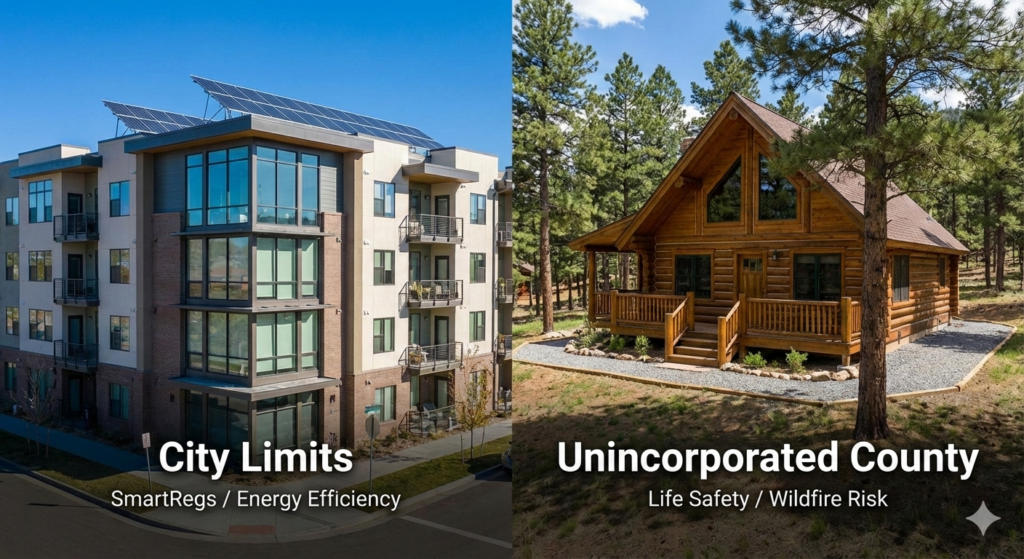
Before we even discuss a single inspection item, we must clarify a point of confusion that trips up countless new STR owners. Boulder County and the City of Boulder are separate jurisdictions with distinctly different requirements for rentals. A property in Gold Hill is not subject to the same rules as a condo on Pearl Street, and confusing them can lead to wasted time and money.
Understanding City of Boulder SmartRegs
If you’ve done any research on rental requirements in the area, you’ve undoubtedly encountered the term SmartRegs. The City of Boulder’s SmartRegs program is an initiative focused on energy efficiency requirements. A SmartRegs inspection, often conducted by a Certified HERS Rater, evaluates a dwelling unit based on a points system for things like insulation, window quality, and the efficiency of HVAC systems. This is a mandatory component of securing a rental housing license within the city limits.
Why Boulder County is Different
The Short-Term Dwelling Rental license for properties in unincorporated Boulder County does not require a SmartRegs inspection. Instead, the focus of the county’s Life Safety Inspection is explicitly on health and safety as defined by the International Property Maintenance Code (IPMC) and local amendments. The certified inspector from Boulder County Community Planning & Permitting is not there to measure your furnace’s energy output; they are there to ensure the property is safe from immediate life-threatening hazards, with an implicit and growing focus on wildfire preparedness.
This distinction is critical. Investing in energy efficiency upgrades to meet SmartRegs criteria when your property is in unincorporated Boulder County will not help you pass your life safety inspection. Your efforts must be directed toward the specific items on the county’s life safety checklist and the broader environmental risks they represent.
Beyond Smoke Detectors: The Wildfire Subtext of the Life Safety Checklist
When you receive the Boulder County life safety checklist, you’ll see items that seem standard for any home. It’s easy to approach this as a simple to-do list. However, a deeper, more scientific understanding reveals how each requirement connects to the overarching threat of wildfire in our Colorado landscape.
Here are some common inspection items and their deeper significance in our unique environment:
- Smoke Detector Placement and Carbon Monoxide Alarms: The building codes are clear on this: smoke alarms must be in each sleeping room, outside each separate sleeping area, and on each additional story of the dwelling. Carbon monoxide alarms shall be installed outside of each separate sleeping area. This is standard. The subtext for a mountain property, however, is early warning. In a wildfire event, smoke can penetrate a home long before flames arrive, and a functioning, properly placed alarm system provides the critical minutes needed for evacuation.
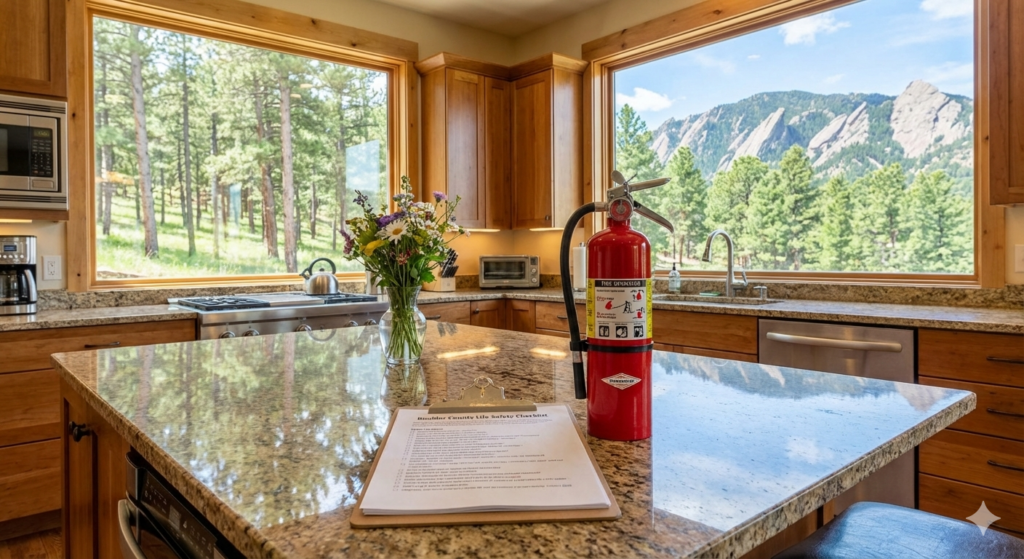
- Fire Extinguisher Requirements: The county requires at least one 2A:10B:C fire extinguisher, visibly located and readily accessible. For a guest unfamiliar with your home, “readily accessible” means in a central location like the kitchen, not hidden in a pantry. This isn’t just for a small kitchen fire; it’s a first line of defense for a stray ember that might ignite a deck or patio furniture.
- Egress Windows and Emergency Exit Plan: Every sleeping room must have a point of egress, typically a window of a specific minimum size, that opens directly to the outside. This is a non-negotiable life safety item. You are also required to post a clear emergency exit plan. In a fast-moving wildfire, the primary exit may be blocked. These secondary exits are vital escape routes. The inspector will check that these windows open easily and are not obstructed.
- Electrical Safety (GFCI Outlets): The inspector will verify that Ground Fault Circuit Interrupter (GFCI) outlets are installed in required locations like kitchens, bathrooms, and outdoor areas. While this prevents electrical shock, it also reduces the risk of electrical shorts, a common ignition source for structural fires that can quickly become wildfires in the WUI.
- Stairway, Guardrail and Handrail Codes: Ensuring stairways are safe with proper handrails and guardrails prevents falls, which is a standard safety measure. In an emergency evacuation, perhaps in low-light or smoky conditions, these elements are crucial for a quick and safe exit from the dwelling.
These are just a few examples. Other items, such as water heater safety (ensuring proper strapping and ventilation) and furnace inspection, all contribute to a home’s overall resilience. Failing to meet these basic standards can lead to safety violations and a lengthy re-inspection process. These are common inspection failures that are easily avoided with proper preparation.
Leveraging Wildfire Partners: The Gold Standard for Mitigation and Insurability
Simply meeting the baseline requirements of the inspection is one thing. Truly securing your investment and ensuring the long-term viability of your short term rental business in Boulder County requires a more robust strategy. This is where Wildfire Partners comes in.
Wildfire Partners is a Boulder County-funded mitigation program designed to help homeowners in the foothills and mountains prepare for wildfire. It provides a clear, scientific roadmap for reducing your property’s risk. Participation is one of the most powerful steps you can take, not just for safety, but for compliance and financial stability.
How the Program Works:
- Application and Assessment: You apply to the program, and a dedicated Wildfire Mitigation Specialist visits your property.
- Customized Report: You receive a comprehensive, customized report detailing your property’s specific vulnerabilities and a checklist of required and recommended mitigation actions. This covers everything from vegetation management to home hardening.
- Action and Re-inspection: You complete the required mitigation work. A specialist then returns to verify the work.
- Certification: Upon successful completion, you receive a Wildfire Partners Mitigation Certificate.
This certificate is far more than a piece of paper. It is a powerful signal to the county inspector and, crucially, to your insurance company. For many owners, maintaining property insurance coverage has become the single greatest challenge of owning a home in the mountains. Insurers are increasingly non-renewing policies for properties they deem too high-risk. The Wildfire Partners program directly addresses this.
In fact, the program offers a clear advantage in the insurance market. The Boulder County Wildfire Partners Mitigation Program offers professional inspections, and its certificate is accepted by insurers like Allstate and USAA as proof of proper mitigation according to researchers. Furthermore, this local initiative has been so successful that the Boulder County Wildfire Partners program has been able to guarantee that participating homeowners are not denied private insurance coverage, even when residing in the wildfire urban interface (WUI) as reported by the Wharton School.
By participating in this program, you are not only taking the most effective steps toward protecting your property but also securing its insurability, a cornerstone of any sound real estate investment.
Defensible Space: Your Compliance and Survival Multiplier
A core component of the Wildfire Partners program and a concept every mountain property owner must master is “defensible space.” This is the buffer you create between your home and the surrounding vegetation. It’s about managing your landscape to slow or stop the spread of wildfire and provide a safe area for firefighters to work.
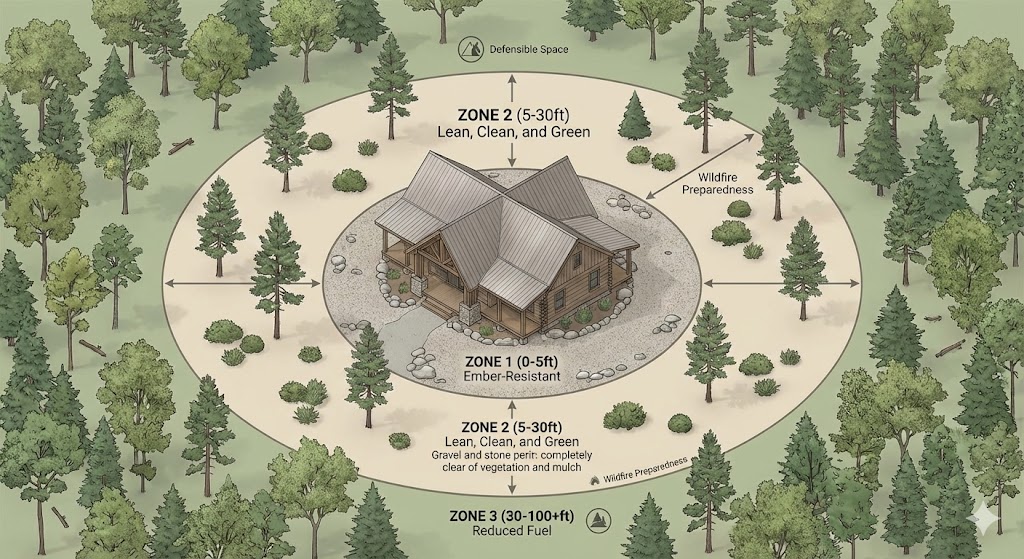
The science of defensible space is well-established and typically involves three zones:
- Zone 1 (0-5 feet from the home): The Ember-Resistant Zone. This is the most critical area. It should be completely free of flammable materials. That means no pine needles on the roof or in gutters, no flammable mulch against the foundation, and no firewood stacked against the house. Decks, siding, and roofing should be made of ignition-resistant materials.
- Zone 2 (5-30 feet from the home): The Lean, Clean, and Green Zone. This area is for thinning and spacing vegetation. You should remove “ladder fuels” (low-hanging branches that can carry a ground fire into the treetops), space out trees, and keep grass mowed low. The goal is to interrupt the fire’s path.
- Zone 3 (30-100+ feet from the home): The Reduced Fuel Zone. This is the transitional area to the surrounding forest. The focus here is on reducing the overall density of vegetation and removing highly flammable dead or dying material.
Creating defensible space is essential for passing the spirit, if not the letter, of the county’s life safety inspections. A property with overgrown vegetation right up to the foundation is an obvious hazard that an inspector will note. More importantly, it directly impacts the concept of “interdependent risk.” Wildfire is considered an ‘interdependent risk,’ meaning the damage a homeowner faces depends on their own mitigation measures as well as those taken by their neighbors as explained in wildfire risk analysis. Your mitigation efforts protect your neighbors, and theirs protect you. This community-wide approach is vital for the resilience of areas throughout Boulder County.
The cost of inaction is staggering. The 2018 Camp Fire in California, the state’s most destructive, caused an estimated $16.5 billion in total damage, with $12.5 billion covered by insurance, making it the most expensive insured disaster that year according to industry reports. Investing in mitigation is not an expense; it is a direct defense against catastrophic financial loss.
Your Approach to Compliance: A Strategic Comparison
As an STR owner, you have choices in how you approach the life safety inspection and overall property readiness. Your choice will have significant consequences for your business’s short-term costs and long-term viability.
Approach 1: Reactive Checklist Compliance
Description: This approach treats the inspection as a simple checklist to be completed as quickly and cheaply as possible. The goal is to do the bare minimum required to get the license.
Pros: Lower upfront cost and less initial effort. It’s the fastest path to getting a “pass” on paper.
Cons: Often leads to re-inspection fees and delays if work is done incorrectly. It completely ignores the underlying wildfire risk, leaving the property vulnerable. This approach does nothing to address insurance non-renewal risk and may foster a false sense of security.
Approach 2: Proactive Wildfire Risk Mitigation
Description: This is the strategic approach centered on the core thesis of this guide. It involves engaging with programs like Wildfire Partners, implementing robust defensible space, and hardening the home against embers.
Pros: Dramatically reduces the real risk of property damage or loss. Secures insurability, often with guaranteed coverage. Protects your investment for the long term and ensures the highest level of guest safety. It positions you as a responsible host in the Boulder County community.
Cons: Requires a greater upfront investment of time and money. The cost and effectiveness of mitigation efforts need to be planned and budgeted for.
Approach 3: Superficial Tidiness vs. Deep Environmental Safety
Description: This is a mindset comparison. One owner focuses on making the property look clean for guests (fresh linens, sparkling kitchens), while another understands that in our environment, true “cleanliness” means managing the surrounding landscape. It’s the difference between a five-star review for comfort and a five-star reality of safety.
Pros of Deep Safety: Creates a genuinely safe haven for guests, reduces owner liability, and builds a reputation based on trust and responsibility, which can be a unique selling point.
Cons of Superficial Tidiness: While aesthetically pleasing, it completely misses the primary threat to the property and its occupants, creating a dangerous illusion of safety.
Frequently Asked Questions About Boulder County STRs
Navigating the various rules can be complex. Here are clear answers to some common questions we hear from property owners.
Does Boulder County allow short-term rentals?
Yes, Boulder County allows short-term dwelling rentals in many zone districts, provided you successfully complete the Short-Term Rental License Application and pass the required life safety inspection. You will also need a sales and use tax license. There are rules regarding occupancy limits and a primary residence requirement may apply in some cases. Always check the latest licensing ordinance with Boulder County Community Planning & Permitting.
What are the driveway standards in Boulder County?
Driveway standards are a critical but often overlooked part of safety. Your property address must be clearly visible from the road. The driveway itself needs to provide adequate access for emergency vehicles, which often means sufficient width, a stable driving surface, and an adequate turnaround area for a fire truck. An inspector will look at this as part of ensuring overall property safety and accessibility.
Are fire pits allowed in Boulder?
This depends on location and current conditions. Both the City of Boulder and Boulder County have strict regulations. Open wood-burning fire pits are often prohibited or heavily restricted, especially during dry conditions. Gas-powered fire pits with a shut-off valve are generally viewed more favorably. You must always check for active fire bans on the Boulder County website before operating any outdoor fire feature. Violations can result in significant fines and present an extreme fire danger.
Do you need a rental license in Colorado?
There is no statewide rental license requirement in Colorado. Licensing is handled at the local level, by the city or county. Therefore, if you operate any short term rental, whether through Airbnb, Vacation Rental By Owner (Vrbo), or independent property management, within the jurisdiction of Boulder County, you absolutely must have a county-issued rental license to operate legally. The same applies to municipalities like Longmont or the City of Boulder, each with their own distinct process.
Making the Right Choice for Your Needs
The optimal path forward depends on your specific goals and circumstances as a property owner. There is no single “best” solution, only the one that is most appropriate for your investment strategy and risk tolerance.
For the New STR Owner:
Your primary goal is to get your business operational quickly and correctly. Focus first on meticulously completing every item on the official Boulder County Life Safety Checklist. Schedule your inspection well in advance. Use this initial process as your baseline education. Once you are licensed and generating revenue, immediately begin planning your long-term mitigation strategy by applying for the Wildfire Partners program. Think of it in two phases: comply now, protect forever.
For the Risk-Averse Investor:
Your property is a significant asset, and your primary concern is long-term investment protection and liability reduction. Your first call should be to Wildfile Partners. The cost and effectiveness of mitigation efforts are your top priority. The guarantee of continued insurance coverage is invaluable and should be the central pillar of your risk management strategy. Passing the county inspection will be a natural and easy byproduct of the comprehensive work you do through this program. Your goal is not just compliance, but creating a hardened, insurable, and defensible asset.
For the Hands-Off Property Manager:
You manage multiple rentals and your priorities are efficiency, reliability, and maintaining five-star reviews that often hinge on guest safety and experience. You need a trusted local expert to handle all compliance and safety protocols. Your best strategy is to partner with a service that understands the scientific principles of mountain home safety, from defensible space to internal air quality. This ensures continuous operation across your portfolio, minimizes your time spent on code enforcement issues, and provides peace of mind that your clients’ properties are not just compliant, but genuinely safe.
Ultimately, the choice of how to proceed rests with you. The path of proactive mitigation is an investment, but one that pays dividends in security, insurability, and peace of mind. For a personalized assessment of your vacation rental’s needs and a clear plan to ensure it is not only compliant but truly safe from the ground up, contact the expert team at Bella’s Mountain Vacation Cleaning today. We are your scientific partner in home safety.
RELATED: Most common cleaning complaints from Airbnb guests leading to refunds
How professional cleaning for your Boulder Airbnb unlocks 5-star reviews
How often to schedule deep cleaning services in Lafayette for a truly healthy
Standard vs deep clean: why the best choice is a strategic cycle
Beyond aesthetics: Why a professional deep cleaning is a critical investment for Boulder
What’s really included in a Boulder professional deep clean for a healthier home?
Why does my house still feel dusty after cleaning? Feedback loops to break
The 2026 Cleaning Consumer Guide