Is a high Airbnb cleaning fee hurting your booking rate in Denver Colorado?
For many Denver Airbnb hosts, a high cleaning fee feels like a primary culprit for lost bookings. However, the real threat to your short-term rental’s success isn’t the fee’s dollar amount but an inflexible policy that becomes a flashpoint for disputes, especially during cancellations, damaging your reputation and bottom line.
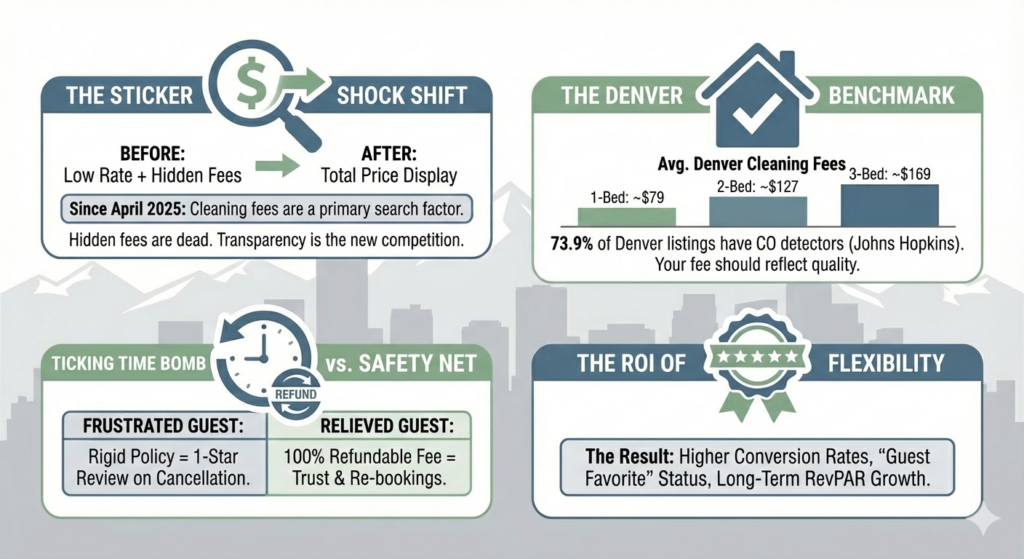
The Hidden Liability: Why Your Cleaning Fee Policy is a Ticking Time Bomb
As a Denver host, you meticulously track your nightly rate, occupancy rate, and listing optimization. You analyze market data to ensure your pricing is competitive, whether your property is a chic loft in RiNo or a charming bungalow near Washington Park. But in this intense focus on per-stay costs, a critical liability is often overlooked: the non-refundable cleaning fee on a canceled booking.
Guests understand paying for a service they receive. What they don’t understand—and what fuels negative guest reviews—is paying a hefty fee for a turnover service that never happens. This isn’t theoretical. Public complaints reveal a clear pattern where rigid ancillary fees, not the base price, create the most significant friction. For example, a customer complaint was filed on June 5, 2023, against vacation rental company Evolve after a refund was denied for a trip cancelled four days prior due to a documented family medical emergency, escalating a policy issue into a public dispute according to the Better Business Bureau. This scenario plays out constantly, turning a potential future guest into a vocal detractor.
The core issue is a disconnect in value perception. The host sees the fee as a fixed part of STR operational expenses, essential for maintaining the property and covering housekeeping costs. The guest, however, sees a specific charge for a cleaning that was never performed. When a family emergency forces a last-minute cancellation for their trip to see a show at Red Rocks Amphitheatre, being charged a $150 cleaning fee feels punitive, not procedural.
How Airbnb’s ‘Total Price’ Display Turns Policy into a Competitive Differentiator
For years, hosts grappled with “price sticker shock,” where a guest would see a low nightly rate only to be surprised by high fees at checkout, leading to booking abandonment. Airbnb’s switch to an upfront pricing display, showing the total booking cost including all fees, was meant to create price transparency. While it solved one problem, it put a magnifying glass on another.
Now, guests see your total price from the very first search. They can easily make a hotel price comparison. This transparency means your cleaning fee is no longer a hidden fee but a component of the total value proposition. If your fee is high, it must be justified by an immaculate property and stellar reviews. But more importantly, when every fee is visible, inflexible policies become glaringly obvious. A guest comparing two similar properties in Capitol Hill might not choose the one with the lower cleaning fee; they might choose the one whose host demonstrates fairness and flexibility in their communication and policies.
This is where revenue management intersects with guest experience. A rigid, non-refundable cleaning fee policy, especially within a strict cancellation window, can negatively impact your booking conversion rate. Guests are more risk-averse than ever, especially after the travel disruptions of recent years. According to Karen Xie, an associate professor at the University of Denver, Airbnb saw cancellations of 85% of its bookings during the initial wave of the pandemic. This event underscored the fragility of travel plans and trained a generation of travelers to scrutinize cancellation terms. An inflexible policy on your cleaning fee is a red flag, signaling a host who may be difficult to deal with if unforeseen circumstances arise.
Answering Your Top Questions About Denver Cleaning Fees
Before we can reframe the fee as a customer service tool, it’s essential to understand the legitimate costs that drive its price. Many hosts contact us at Bella’s Mountain Vacation Cleaning asking these very questions.
Why is my Airbnb cleaning fee so high?
A professional cleaning fee isn’t just for a quick wipe-down. It’s a comprehensive turnover service that accounts for several factors unique to our city. This includes the high cost of living in Denver, which affects labor rates, and the meticulous cleaning protocols required for guest safety. Our process involves using non-toxic, eco-friendly products to ensure a healthy environment. The fee covers the direct cleaning time and labor, the consumable supplies cost (from microfiber cloths to our proprietary plant-based disinfectants), and administrative overhead. It’s a direct reflection of the cost to reset your property to a pristine, guest-ready state.
What is considered a reasonable Airbnb cleaning fee?
There is no magic number. A reasonable fee is one that accurately reflects the work required. For a 600-square-foot condo in LoHi, the fee will be vastly different from a four-bedroom house near the University of Denver. The best approach is a breakeven analysis. Calculate the actual cost of your professional turnover service. A reasonable fee covers that cost plus a small margin. Trying to turn the cleaning fee into a major profit center is what often leads to an inflated price that deters guests and feels unfair during cancellations. Market data from tools like PriceLabs can help, but it must be balanced with your actual housekeeping costs.
What is considered excessive cleaning on Airbnb?
Excessive cleaning isn’t about the fee’s price but about what it’s used for. The standard fee should cover a full turnover: laundry, sanitizing kitchens and baths, vacuuming, mopping, and restocking consumables. It is not for repairing damage, removing deep stains from upholstery, or extensive trash removal from a party. Those situations are what your damage deposit and host insurance are for. Charging a guest extra for “excessive cleaning” because they used every pot and pan is poor form; that’s simply the cost of doing business in the short term rental market.
How long should it take to clean a 3 bedroom Airbnb?
For a standard 3-bedroom, 2-bathroom short term rental property in a Denver neighborhood, our teams typically budget between 3.5 and 5 hours for a complete, health-focused turnover. This allows for meticulous attention to detail, from disinfecting high-touch surfaces to ensuring the space is free of allergens and chemical residues. Rushing this process compromises quality and guest safety, which is why basing a fee on real-time estimates is crucial for justification.
The Critical Decision Factors: Price vs. Policy vs. Reputation
As a host, you’re constantly balancing competing priorities. When it comes to the cleaning fee, the tension lies between maximizing revenue, ensuring operational smoothness, and building a five-star brand. Here’s a breakdown of where to focus your energy.Cleaning Fee Amount/Pricing
- Pros: A higher fee can increase your per-booking host payout and ensure all cleaning costs are covered. It can also dissuade guests looking for a “party house” or those who might be less respectful of the property.
- Cons: An excessively high fee can decrease your booking pace and hurt your search ranking algorithm placement, as total price is a major factor. It becomes a primary point of contention and can lead to lower “value” scores in guest reviews, jeopardizing your Superhost status or Guest Favorite badge.
Cancellation Policy Flexibility
- Pros: A flexible policy, especially one that automatically refunds the cleaning fee upon any cancellation, is a powerful marketing tool. It builds immense trust, reduces guest friction, and can significantly boost your booking conversion rate by lowering the perceived risk for travelers.
- Cons: This approach requires more active guest communication and management during cancellations. In rare cases of extremely last-minute cancellations where a cleaning service has already been dispatched, it could represent a minor financial loss if not managed properly with your cleaning partner.
Brand Reputation & Guest Disputes
- Pros: Prioritizing reputation above all else leads to overwhelmingly positive reviews, repeat bookings, and a strong direct booking website strategy. It creates a brand that guests trust, allowing for a higher average daily rate (ADR) over the long term.
- Cons: A “guest is always right” mentality can sometimes feel frustrating and may lead to absorbing costs that, while contractually the guest’s responsibility, are not worth the public dispute. This requires a long-term view of STR profitability over short-term gains.
Gain a Competitive Edge in Denver with a Guest-First Fee Strategy
The Denver vacation rental market is sophisticated. Travelers flying into Denver International Airport (DIA) for a conference at the Colorado Convention Center or planning a family trip during the Colorado ski season have countless options, from STRs to traditional hotels. You can stand out not just with beautiful photos, but with superior hospitality.
This is proven by local market dynamics. A fascinating 2018 study found that among 16 U.S. cities, Denver had the highest percentage of Airbnb listings (73.9%) with self-reported carbon monoxide detectors according to researchers at Johns Hopkins University. This indicates that Denver hosts and guests prioritize non-price factors related to safety and well-being. A fair and compassionate cleaning fee policy aligns perfectly with this mindset.
Adopt and actively market a “Guest-First” cleaning fee policy. State it clearly in your listing description: “Life happens! If your plans change and you need to cancel your stay for any reason, our cleaning fee is 100% refundable.” This simple statement dismantles a major point of anxiety for potential guests. It differentiates your listing from competitors with rigid rules and builds a foundation of trust before the booking is even made. It turns your cleaning fee from a potential liability into a feature that helps you win the booking.
Making the Right Choice for Your Needs
The optimal strategy is not one-size-fits-all. It depends on your personal goals, financial structure, and management style for your Denver STR.
The Professional Host
If you manage multiple properties and your focus is on maximizing RevPAR and minimizing operational friction, your primary concern is scalable systems. Public complaints are a significant time drain and brand risk. For you, the most effective strategy is implementing a universally refundable cleaning fee policy. The small potential loss on a rare, ultra-last-minute cancellation is insignificant compared to the time saved arguing with guests, the improved booking conversion, and the protection of your brand’s reputation across platforms like Airbnb and Vrbo.
The Casual Host
If you rent a second home or a basement apartment to supplement your income, your priorities are different. You want great reviews and to avoid personal financial strain. For you, a balanced approach works best. Maintain a strict cancellation policy for the nightly rate to protect your income, but make your cleaning fee fully refundable. This demonstrates goodwill, protects you from the most common source of guest disputes, and encourages the positive reviews that are vital to your success, all without exposing you to significant financial loss.
The Guest with an Emergency
As a traveler, when you’re forced to cancel a trip due to a family illness, flight cancellation, or other emergency, the last thing you want is a battle over ancillary fees. Your priority is compassion and flexibility. Look for hosts who explicitly state a fair policy in their listing. If it’s not mentioned, send a polite inquiry before booking. A host’s response to a simple question like, “I see you have a strict cancellation policy, but could you clarify if the cleaning fee would be refunded if we had to cancel?” will tell you everything you need to know about their approach to hospitality.
Ultimately, the debate over the perfect cleaning fee price in Denver is a distraction. The real opportunity lies in transforming your policy from a point of friction into a pillar of trust. By focusing on a flexible, guest-centric approach, you not only avoid brand-damaging disputes but also create a powerful competitive advantage that attracts more and better bookings for your short term rental.
At Bella’s Mountain Vacation Cleaning, we partner with hosts across Denver to implement cleaning protocols that guests love and policies that protect your reputation. For a personalized assessment of your turnover needs and a free quote based on a health-focused approach, contact our expert team today.
RELATED: Why your ‘visibly clean’ property gets 4-star cleanliness reviews and what to do about it
The 5 most common cleaning complaints from Airbnb guests that lead to refunds
Most common cleaning complaints from Airbnb guests leading to refunds
How professional cleaning for your Boulder Airbnb unlocks 5-star reviews
How often to schedule deep cleaning services in Lafayette for a truly healthy
Standard vs deep clean: why the best choice is a strategic cycle
Beyond aesthetics: Why a professional deep cleaning is a critical investment for Boulder
What’s really included in a Boulder professional deep clean for a healthier home?
Why does my house still feel dusty after cleaning? Feedback loops to break
The 2026 Cleaning Consumer Guide