

Why Colorado road salt is destroying your Evergreen hardwood floors
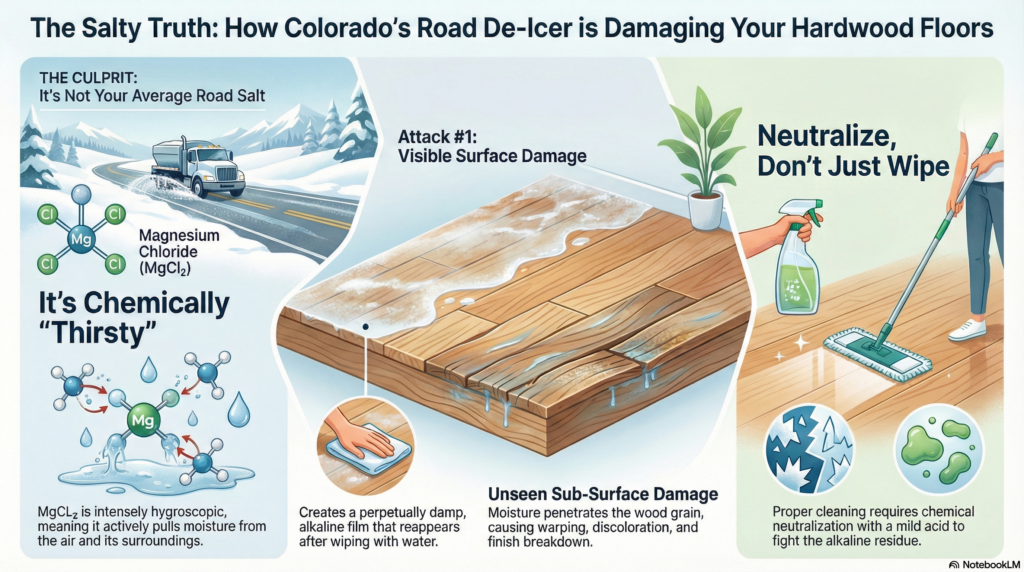
Why Colorado road salt is destroying your Evergreen hardwood floors and the real way to clean it
The white film on your Evergreen hardwood floors is not the rock salt you spread on your own walkway. It is magnesium chloride, one of the two de-icing compounds the Colorado Department of Transportation uses on state highways, and it behaves in a way plain salt does not. Water will not remove it. Water spreads it.
I have been cleaning mountain homes from Black Hawk to Evergreen since 2016, and the winter haze is one of the most common things homeowners ask me about. If your floors are due for a proper winter reset, that is part of what our mountain home cleaning services cover. Before you mop again, it helps to know what you are actually fighting.
What is really on the floor?
The answer is a liquid de-icer, not a rock salt. CDOT’s two primary winter compounds are a salt and sand mixture and liquid magnesium chloride, and a federal highway research report found CDOT has been shifting from the salt and sand mix toward the liquid over the past several years. A 2010 CDOT release lists magnesium chloride in solutions up to 30 percent, effective on pavement down to 16 degrees Fahrenheit, plus a cold-temperature modified version rated below 15 degrees.That distinction matters more than the brand name. Sodium chloride, the rock salt most people picture, is mostly abrasive. It scratches. Magnesium chloride is chemical. It stays liquid longer, it spreads farther across a floor, and it holds onto water.
Why does it come back even when I mop?
Because magnesium chloride pulls moisture out of the air and stays wet. This is a measured property called deliquescence, and magnesium chloride’s threshold sits around 33 percent relative humidity. The numbers are consistent across three independent sources. The Getty Conservation Institute’s CAMEO materials database lists the deliquescence point at 33.6 percent RH at 20 degrees Celsius. A 2013 study in the Journal of Physical Chemistry A measured magnesium chloride particles and found deliquescence at 33 percent RH. A 2019 study in Atmospheric Chemistry and Physics puts the range at 33 to 34 percent across 0 to 40 degrees Celsius.
The same 2013 study found something more useful for anyone living up here. Magnesium chloride also holds water at 12 to 15 percent relative humidity, well below its published threshold. That is why the residue can still feel damp in a heated mountain home in January, when the indoor air is about as dry as it gets.So when you mop with water, you dissolve the residue and push it into a thinner layer. The water evaporates. The salt stays. It draws moisture back, and the film returns, often within hours.
Why does this hit Evergreen homes harder than Front Range homes?
Elevation and sun.Evergreen runs around 7,200 feet. Winter indoor humidity up here drops lower than it does on the plains, and low indoor humidity does not dry the residue out the way you would expect. It holds water it already absorbed, and it keeps a slightly damp film sitting against your finish. My Evergreen service page covers the rest of what changes at this elevation, from well water to the way floors behave through a freeze.Then the sun does its part. Mountain homes tend to have big south and west glass, and light through a window landing on a damp residue is a long, slow exposure your finish did not ask for.
Does vinegar neutralize road salt on hardwood?
No. This is the advice worth unlearning. Vinegar is an acid, and the National Wood Flooring Association says plainly in its consumer care guidance not to use vinegar on wood floor finishes because it degrades the finish.
You will find the vinegar tip in a lot of places, usually at a strength that makes it worse. A common version is one cup of white vinegar per gallon of water. Even guidance written for people who want to use vinegar anyway puts the ceiling closer to half a cup per gallon, for occasional spot use only. The old version of this article repeated the one-cup version. That was wrong, and I have corrected it.
The residue on your floor is not an alkaline problem that needs an acid. It is a chloride salt that is holding water. The goal is to get it off without stripping the finish that protects your wood. Acid works against that goal.
If you are not sure what finish is on your floor, stop before you try anything and check with the manufacturer first. That is what I do before I touch a floor I have not seen before.
What actually removes it?
Two steps, both done with very little moisture. Step one is residue removal with a product made for your floor’s finish. De-icer residue removers exist for sealed wood floors, and they are not the same thing as an all-purpose cleaner. Apply to a microfiber pad rather than pouring onto the floor. Give it the dwell time on the label. Remove it completely.
Step two is a pH-neutral cleaner made for hardwood. The NWFA’s guidance on moisture is to keep it minimal: a barely damp mop, wrung out, with as little water left on the surface as possible. Standing water is what causes cracks, cupping, and warping, and it can leave its own residue behind.Then dry the surface. Do not let it air dry with product still on it.
Can you stop it before it gets inside?
Mostly, yes. The fight is won at the door.
- Two mats at every entry: a scraper mat outside, an absorbent one inside.
- A boot tray by the door, and a no-shoes rule you actually enforce between November and April.
- Dry mop the entry path daily. Fine grit plus moisture is what builds the film.
- Clean the entryway and the first few feet of floor weekly through the winter.
- Wipe dog paws. Chloride residue irritates pads, and paws carry it further into the house than boots do.
For your own walkway, a non-chloride de-icer such as calcium magnesium acetate tracks in less than rock salt.
Both get called “salt,” and they are not the same
| Sodium chloride (rock salt) | Magnesium chloride | |
|---|---|---|
| How it damages wood | Mostly abrasive. Scratches the finish. | Chemical. Holds water against the finish. |
| What it looks like on the road | Solid, sometimes mixed with sand | Liquid, or solid blended with magnesium chloride |
| Cold performance | Loses effectiveness at lower temperatures than chloride alternatives | CDOT lists solutions up to 30 percent effective to 16 F, and a modified version below 15 F |
| Why water alone fails | Re-dissolves and dries | Re-dissolves, spreads thinner, and re-wets itself from the air |
What should you ask before you hire someone for this?
Three questions will tell you most of what you need to know.
Ask what is on the floor. A company that talks about “road salt” in general has not thought about it. Magnesium chloride and sodium chloride need different handling, and if they do not know which one they are dealing with, they cannot pick the right product.
Ask what they use on a sealed hardwood finish, and whether it is pH-neutral. If the answer is vinegar, or “a good mop and some cleaner,” keep looking.
Ask about moisture control. On a wood floor the water itself is the risk. A company that floods the floor and lets it air dry is adding to your problem instead of removing it.
If your floors have gone a whole winter without being properly cleaned, or you are not sure what finish you are standing on, I can look and tell you what you are dealing with. Get in touch and I will take a look.The film on your floor is not dirt, and it is not the rock salt you bought at the hardware store. It is magnesium chloride holding water against your wood, and the way to get it off is to remove the residue without soaking the floor.
Frequently asked questions
Can I use vinegar to clean road salt off hardwood floors?
No. Vinegar is acidic, and the National Wood Flooring Association’s consumer care guidance says not to use it on wood floor finishes because it degrades the finish.
Why does the white film come back after I mop?
You are looking at magnesium chloride, which holds moisture from the air. Mopping with water dissolves it and spreads it thinner. When the water dries, the residue is still there and it re-wets itself.
How often should I clean my floors in winter?
Dry mop the entry path daily and clean the entryway and first few feet weekly. Save the full two-step treatment for when you actually see haze on the floor.
Is road salt the same as the salt on my walkway?
Usually not. Most walkway products are sodium chloride. The liquid de-icer CDOT uses on state highways is magnesium chloride, and that is the one that holds water against a wood finish.
RELATED: Why your ‘visibly clean’ property gets 4-star cleanliness reviews and what to do about it
The 5 most common cleaning complaints from Airbnb guests that lead to refunds
Most common cleaning complaints from Airbnb guests leading to refunds
Standard vs deep clean: why the best choice is a strategic cycle
Why does my house still feel dusty after cleaning? Feedback loops to break


